How to Choose European Project Rooms Your Team Will Actually Open
Project rooms are not notes, forms, or personal task lists. A practical guide to Stackfield — and how to tell secure German collaboration from neighbouring Productivity tools.
The EuroMakers Editorial Team
Researching European software

The Journal · Made in Europe
Some teams do not need another personal todo app. They need a room. A place where tasks, chat, documents, and meetings live together — without scattering the week across five tabs and a default project suite that feels louder than the work.
In EuroMakers, that job sits in Productivity. Stackfield is the German collaboration platform built for secure project rooms: tasks, discussions, documents, and video calls with German data hosting. It is an alternative to Asana and Basecamp for teams that want the project in one place — not another suite they open only under pressure.
Name the room you are missing
Write the sentence that describes this week's friction — before you compare feature tables.
- We need one secure place for tasks, chat, files, and meetings — with German hosting and permissions we can explain to a client.
- I need a personal or team task board I can self-host — not a full collaboration suite.
- I need calm collaborative lists for work and life — not rooms, roles, and video calls.
- I confuse project rooms with notes or forms — and keep shopping for one product that does every Productivity job badly.
If the pain is "our project lives in six places," you want a room. If the pain is "my tasks have nowhere calm to sit," you want a list or board. Made in Europe is the quality bar either way — craft, clarity, and tools shaped by European makers — not a rule that one vendor must own every collaboration habit.
Stackfield — German project rooms you can explain
Stackfield, from Germany, combines task and project rooms, secure messaging, document collaboration, video meetings, granular permissions, and German data hosting. It is aimed at organizations that want project management without stretching an everyday cloud default into confidential work.
Choose Stackfield when the job is a shared room: teams with client boundaries, agencies juggling confidential delivery, or any group that needs chat and documents next to the task board — not bolted on as afterthoughts. If you only need a self-hosted kanban, look at Vikunja. If you want beautiful personal-and-team lists, look at Superlist. Those are neighbouring jobs in the same directory shelf.
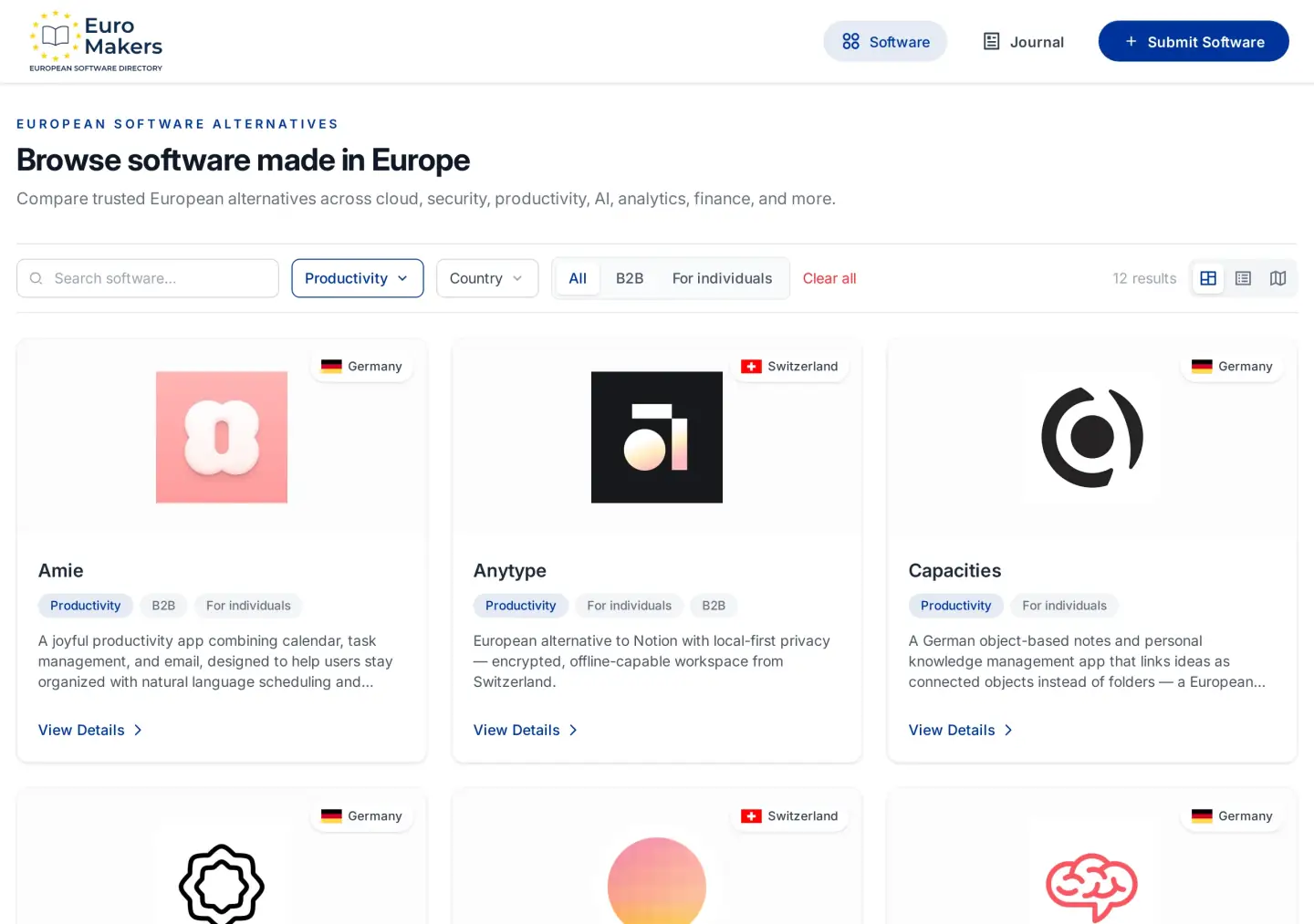
Neighbouring jobs on the same shelf
Productivity is crowded because the word means too many Tuesdays. Keep Stackfield in its lane by naming the neighbours honestly.
- Secure project rooms → Stackfield for tasks, messaging, documents, and meetings under German hosting.
- Self-hosted task boards → Vikunja when you want kanban, lists, and ownership without a full collaboration suite.
- Calm collaborative lists → Superlist when the job is lists that work for work and life, not rooms and roles.
- Notes, knowledge, and thinking tools → covered in our notes and knowledge guide — Capacities, Anytype, Nuclino, Slite, and friends.
- Forms and signatures → covered in our forms and signing guide — Tally collects answers; Documenso closes agreements.
Treating Stackfield as "the European Asana" only works if Asana was already the room you meant. If you were really leaving Notion, Todoist, or Typeform, start with those guides instead.
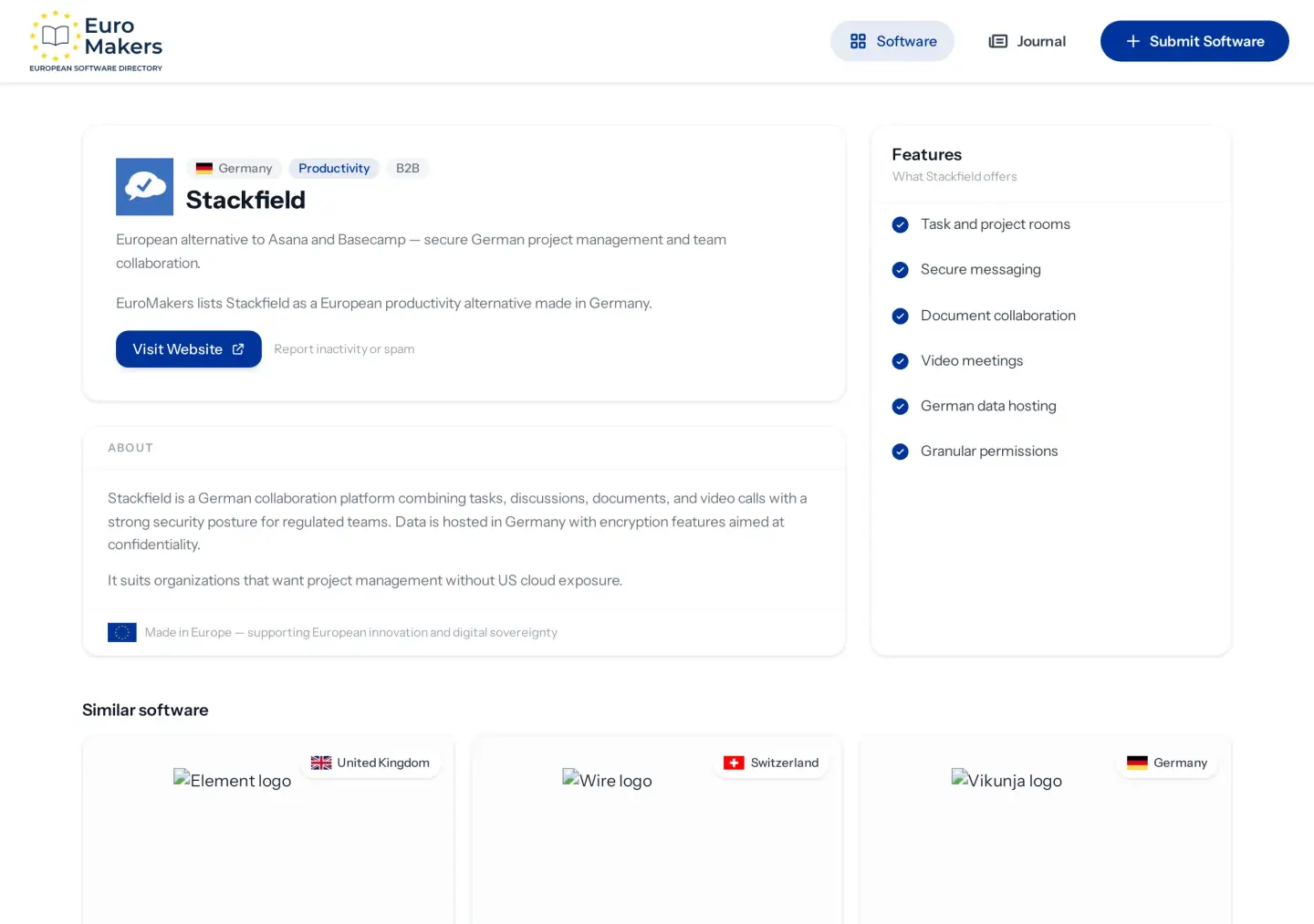
Pick by the room, not the category label
- You need tasks, chat, docs, and meetings in one secure German workspace → begin with Stackfield.
- You need task boards you can self-host → look at Vikunja.
- You need calm lists for personal and team work → look at Superlist.
- You need thinking tools or paperwork, not project rooms → read the notes guide or the forms guide.
None of these is a perfect clone of an everyday project default. They are better at finishing a specific collaboration job with European craft — which is usually what you wanted when the old suite started feeling like furniture you never chose.
Trial one room, not the whole company
Project tools fail when the trial is a company-wide redesign. Keep the experiment tiny.
- Pick one live project — one client delivery, one launch, one internal initiative — not every board you own.
- Rebuild that single room in Stackfield: tasks, the chat thread that matters, and the documents people actually open.
- Invite two colleagues. Watch whether they return without a reminder. Check permissions, mobile access, and how a video call fits the room.
- Decide after one finished week, not after a feature spreadsheet. The room you reopen next Monday is the one that stuck.
If half your friction is personal todos and half is team rooms, trial siblings in parallel. Do not wait for one European product to absorb every habit.
Honest limits
Stackfield will not replace a global enterprise program-management platform with a decade of custom workflows and a long integration list. Vikunja will not replace a full secure collaboration suite. Superlist will not replace project rooms with roles, document spaces, and meetings. European tools on this shelf win on clarity, hosting posture, and speed for the jobs most teams actually have.
That is also the point of Made in Europe here: premium collaboration that feels like a well-built room — not another heavyweight project surface your team opens only when someone escalates.
The best project tool is the room your team still opens on a quiet Tuesday.
— EuroMakers Editorial
Start here
Open Productivity, read the Stackfield listing, and pick the room you are missing this week. If you want help finding a neighbouring European tool — or a category we have not covered yet — tell us. New to the EuroMakers Journal? Start with how the Journal works, the notes and knowledge guide, or the forms and signing guide if your next swap is thinking tools or paperwork rather than project rooms.
Find your next European tool
Browse a curated directory of software made in Europe across every category your team relies on.
Explore the directory
