How to Choose European Search, Delivery, and Observability Tools
After the product exists, three jobs still break weeks: findability, the delivery platform, and what you can see in production. A practical guide to Meilisearch, Algolia, Elastic, GitLab, and Grafana.
The EuroMakers Editorial Team
Researching European software

The Journal · Made in Europe
The first developer tools guide covered the layer you are building — editors, pipelines, mocks, automation, vectors, commerce, billing. This one covers what breaks after the product already ships: search that feels instant, a delivery platform the team can trust, and dashboards that tell the truth before customers do.
Those jobs still live in the same Developer Tools category on EuroMakers. France ships search engines. The Netherlands roots a DevSecOps platform and a search-and-observability stack. Sweden shapes the dashboards teams open when something is wrong. The useful move is the same as before: name the stuck layer, then hire the European tool that owns that job.
What broke after launch?
Skip the mega-roundup. Write the sentence that already sits on your calendar.
- Users cannot find products, docs, or help — search feels slow, brittle, or rented from a stack we barely understand.
- Source, reviews, pipelines, and security live in five tabs — we need one delivery platform we can run or host ourselves.
- Incidents arrive as customer tickets — we need metrics, logs, and traces we can actually read.
- We already like Buddy for approachable CI — but we still need Git hosting, security scanning, and planning in one place.
That sentence is the shortlist. Made in Europe is the quality bar — craft, clarity, and tools shaped by makers across the continent — not a rule that one vendor must own search, shipping, and sight at once.
Five European tools, three ops jobs
Here is a practical cut of the catalog for the layers that break after launch — three search personalities, then a delivery platform, then an observability home.
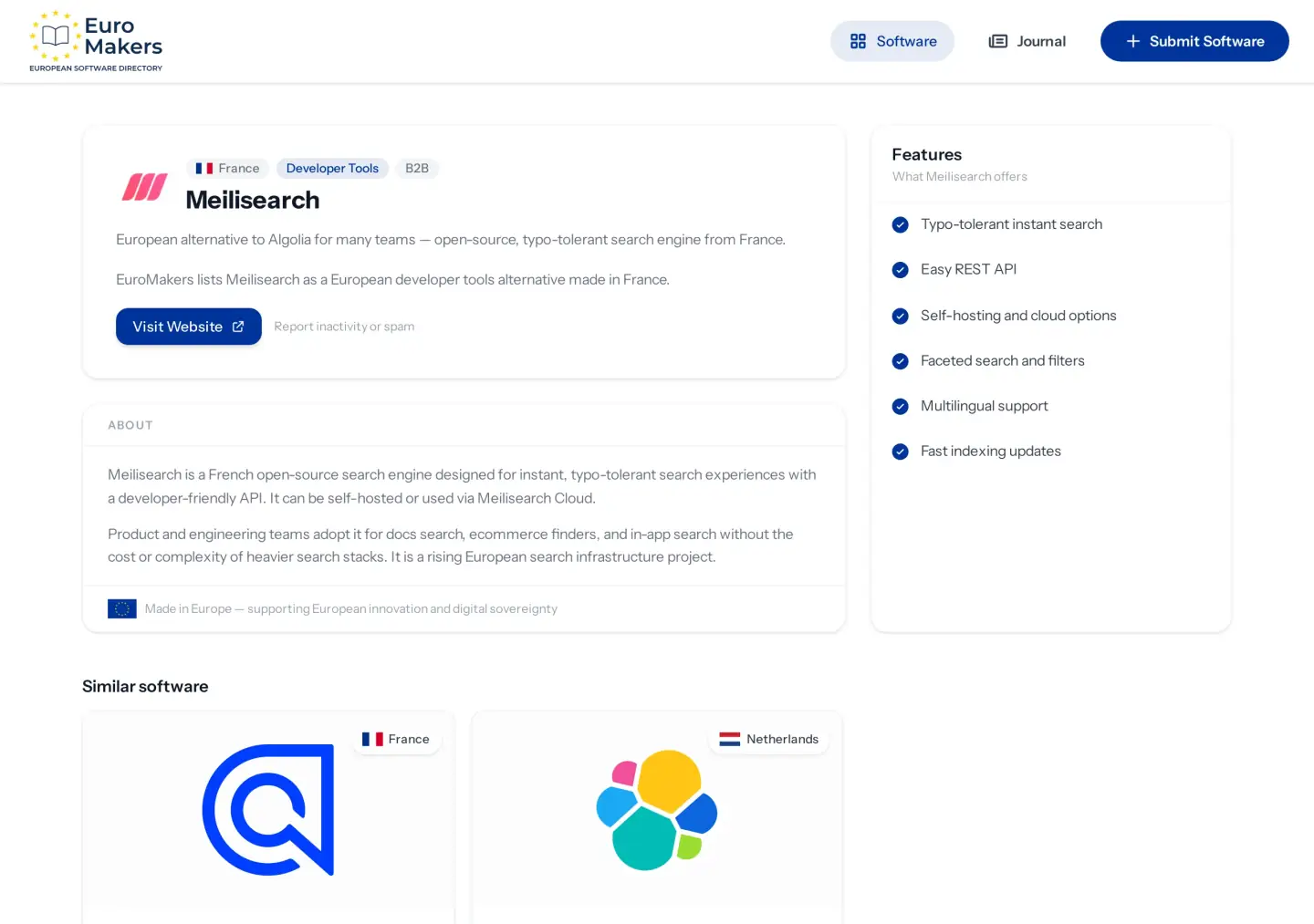
Meilisearch — French search you can own
Meilisearch is a French open-source search engine built for instant, typo-tolerant experiences with a developer-friendly API. Self-host it or use Meilisearch Cloud. Teams reach for it for docs search, ecommerce finders, and in-app search when they want speed without the weight of a heavier stack.
Choose Meilisearch when the job is search you can run and understand — typo tolerance, facets, multilingual indexes, and fast updates without a heavyweight hosted stack. It is the European option many teams mean when they want Algolia-like feel with an open path.
Algolia — Paris-hosted search and discovery
Algolia is a Paris-founded search and discovery platform — hosted APIs for keyword search, recommendations, AI-assisted retrieval, merchandising, analytics, and A/B tests. It is built for product and engineering teams that want relevance as a service, not as a weekend of cluster care.
Choose Algolia when the job is hosted search quality at product scale — ecommerce finders, content discovery, SDKs that ship with the app. It remains one of France's clearest developer-infrastructure exports. If you need self-hosted control first, start with Meilisearch instead.
Elastic — Amsterdam-origin search and ops stack
Elastic was founded in Amsterdam and built the Elastic Stack — Elasticsearch, Kibana, and related products — used worldwide for search, logging, security analytics, and observability. Cloud and self-managed paths cover site search, SIEM, and operations work at serious scale.
Choose Elastic when the job is search plus operational depth — not only a product finder, but logs, security analytics, and visualization in one origin story. It is a different hire from Meilisearch's focused finder or Algolia's hosted discovery API. Do not force it into a lightweight docs-search slot.
GitLab — Dutch-rooted DevSecOps platform
GitLab began in the Netherlands and grew into a full DevSecOps platform: Git hosting, merge requests, CI/CD, security scanning, issue and epic planning, plus package and container registries. Use GitLab.com or self-manage on your own infrastructure.
Choose GitLab when the stuck layer is the whole delivery home — source, review, pipelines, and security in one application instead of a scattered toolchain. It is a sibling to Buddy, not a twin: Buddy shines when you want approachable visual CI and preview environments; GitLab is the bet when you want the platform around the pipeline too.
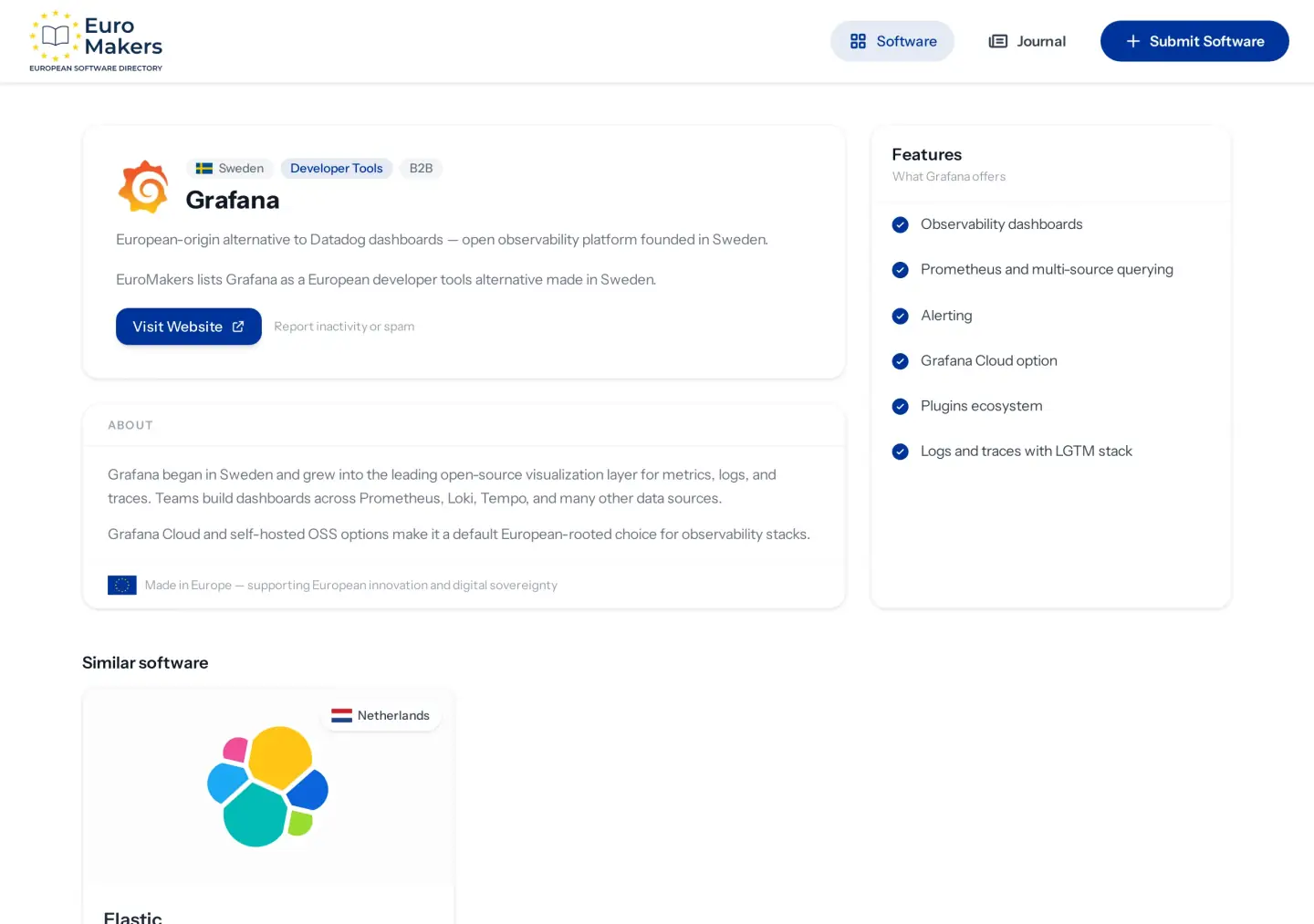
Grafana — Swedish dashboards for what is running
Grafana began in Sweden and became the open visualization layer for metrics, logs, and traces. Teams build dashboards across Prometheus, Loki, Tempo, and many other sources — with Grafana Cloud or self-hosted OSS when they want ownership of the glass they watch.
Choose Grafana when the job is seeing production clearly — alerting, multi-source queries, and a plugin ecosystem that matches how you already collect data. Pair it with Elastic when you need a broader search-and-security analytics story. Do not pretend dashboards replace a search API for your customers.
A shortlist by the ops layer
- Instant, typo-tolerant search you can self-host or cloud-run → start with Meilisearch.
- Hosted search, recommendations, and merchandising at product scale → try Algolia.
- Search plus logging, SIEM, and ops analytics in one stack → evaluate Elastic.
- Source, CI/CD, security, and planning in one DevSecOps platform → look at GitLab.
- Approachable visual CI and preview environments (not the whole platform) → keep Buddy in mind from the first developer tools guide.
- Dashboards and alerts across metrics, logs, and traces → open Grafana.
France shapes the finders. Amsterdam roots Elastic's stack and GitLab's platform story. Sweden lights the dashboards. That spread is continental craft — specialized tools across countries, not one distant vendor pretending to own every ops layer.
Change one ops layer for one honest sprint
Search, delivery platforms, and observability fail in production — not in a feature matrix. Keep the first trial small enough to reverse.
- Pick one stuck ops layer and one European candidate from the shortlist above.
- Run it beside the current tool for a single sprint — index one site section, migrate one project, or dashboard one service.
- Measure the boring truth: time to first useful result, failure modes, docs quality, and how loud on-call feels.
- Write down what would break if you kept it — hosting ops, licenses, team habits, vendor integrations.
- Only then expand: a second index, a second team, or the next ops layer.
Made in Europe, felt when something breaks
Made in Europe earns its place here as a premium quality label — finished developer experience, restrained defaults, and tools built by people who still care how a workday feels when search is empty, a pipeline is red, or a dashboard stays quiet.
Unity shows up as range. A French search engine, a Paris discovery API, an Amsterdam-origin ops stack, a Dutch-rooted DevSecOps platform, and a Swedish observability layer can share one catalog without collapsing into one brand. That is makers across the continent working as one premium label — continental craft, not one distant vendor pretending to own every ops layer.
Name the ops layer that is stuck — then pick the European tool that owns that job.
— EuroMakers Editorial
Start here
Open the Developer Tools category, read the listings that match your stuck ops layer, and give one candidate a single honest sprint. For the layers you build before launch, revisit European developer tools by stack layer. If the next question is where to host, keep going with European cloud hosting — or the editorial on the European swap that sticks. Missing a European search or ops tool we should list? Tell us.
Find your next European tool
Browse a curated directory of software made in Europe across every category your team relies on.
Explore the directory
