Bitculator Is One Person in Denmark, and the Dutch Come Last
Bitculator wants to be the European CoinMarketCap: a crypto data site built and run by one Danish developer since 2021, hosted on Hetzner, free to use, funded partly by on-chain donations. Its own exchange table scores the only European exchange last.
Inês Valente
Journal editor, Lisbon

The Journal · Made in Europe
The submission reached our queue on 19 October, and the pitch inside it was unusual in one specific way: not "we are like CoinMarketCap," but "we replace CoinMarketCap and CoinGecko (both non-European)." Fair. CoinMarketCap belongs to Binance since 2020; CoinGecko is a Malaysian company. The European slot for crypto market data is genuinely empty, and the thing claiming it is not a startup. It is one man in Denmark named Christian Lauridsen, who signs as 'cc' and has been building Bitculator alone since 3 January 2021.
I spent the morning on the site expecting a skin over someone else's API. The about page insists otherwise, and the surface area backs it up: the market-data ingestion, a charting engine with a 90-indicator library, the analytics, and the public API are all written in-house. "Nothing here is a rented widget" is the kind of claim I normally discount. Then I found the changelog page — four products, each with its own dated log: the Data API at v1.3.2, the embed widgets, the MCP server, and something called Bitculator AI, all touched on 3–4 October. A solo dev who versions four products separately is either very organized or lying in an extremely laborious way.
The claim the catalog can't carry
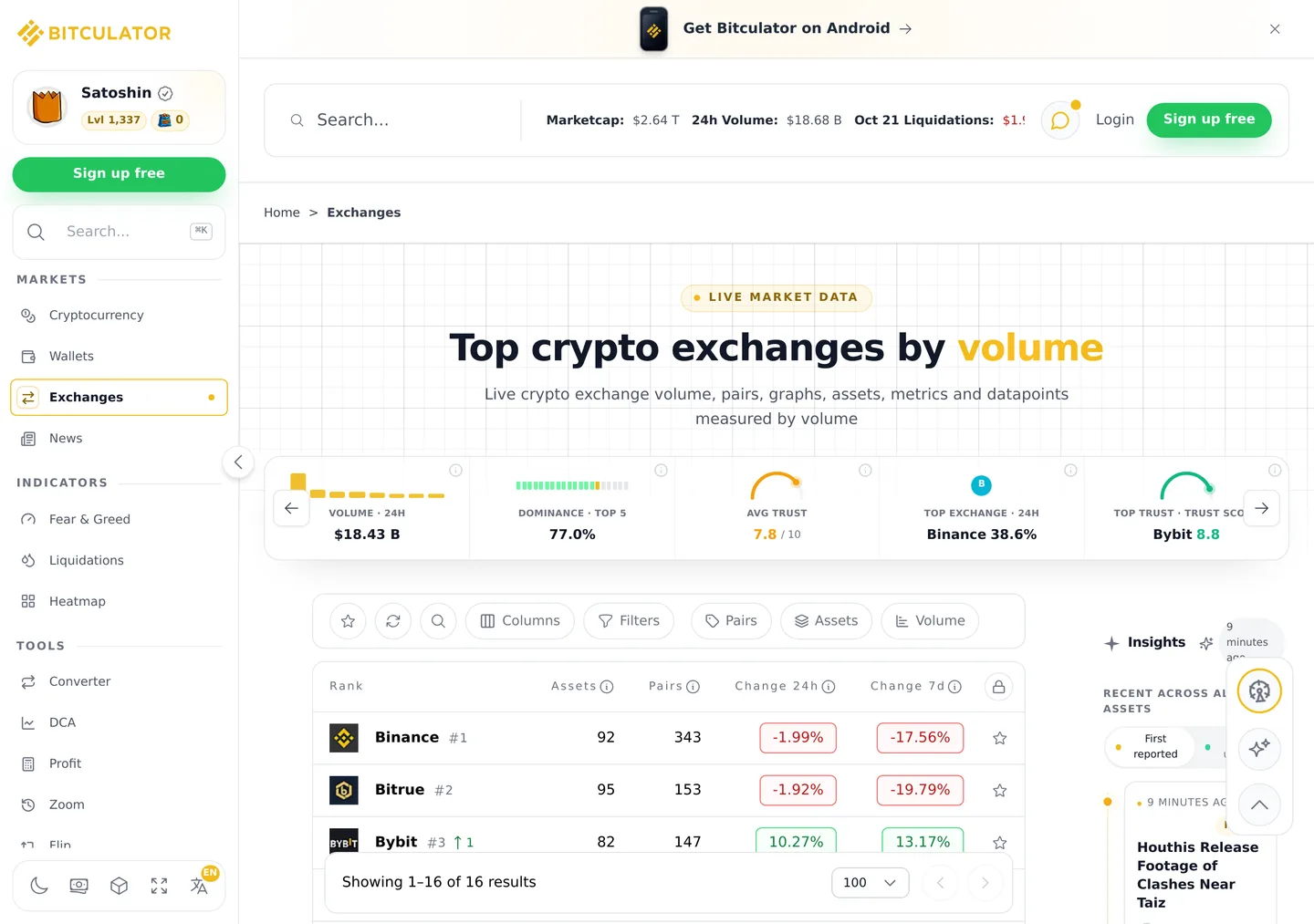
Here is the part I keep turning over. Bitculator publishes a trust score from 0 to 10 for every exchange it tracks — sixteen of them. Binance leads on volume with an 8.5. Scroll to the bottom and the last row is Bitvavo at 5.2: the Amsterdam exchange, the only European venue on the table. The European-made site does not grade on nationality. Whatever else the trust formula is doing, it is not flying a flag, and that makes the site's European claim more believable to me, not less. The methodology itself is not published anywhere I could find, which is the honest caveat — a trust score without a formula is still an opinion, just a consistent-looking one.
The money is the other product fact. The core site is free without an account — 115 assets, 306 wallets, 27 languages, a Fear & Greed index per coin, and a bullish-or-bearish verdict assembled from 25 indicators. Revenue comes from optional memberships and a metered Data API: 10,000 free requests a month, an OpenAPI spec, and SDKs in eight languages including COBOL-adjacent breadth like C++ and .NET. And then there is a donate page that accepts 19 coins on-chain, "no middleman — straight to a solo builder." A CoinMarketCap replacement funded partly by QR-coded tips is very crypto, and it means the free tier is subsidized by whoever finds the numbers worth a satoshi.
Built for the next reader, who may not be human
Bitculator ships an MCP server — 19 tools, structured output schemas, its own changelog. Its submission wasn't even the only one this week to lead with an MCP endpoint; an astrology site from Bulgaria arrived the next day with the same feature. Reading the market is no longer something only humans do with eyeballs, and a one-person operation noticed that before most funded teams. The same pattern I noted in eM Client's MCP read access, except here the product is data itself.
What I cannot verify from the outside is the obvious fragility: one person holding a 16-exchange ingest pipeline through the next volatility spike, one set of hands on the trust scores, the API keys, and the on-chain tip jar. The 2021 start date argues he has survived a few already. For a reader deciding between this and an incumbent owned by the biggest exchange it ranks, the independence is not a slogan on Bitculator — it is the staffing plan.
Find your next European tool
Browse a curated directory of software made in Europe across every category your team relies on.
Explore the directory
