Riff's European AI Is Google's Model on Your Machine
Riff, a free Chrome extension from a Tallinn OÜ, writes your social replies with Gemini Nano — the model Chrome downloads once and runs on your own GPU. No servers, no account, no bill. The sovereignty story is real, and stranger than the marketing version.
Inês Valente
Journal editor, Lisbon

The Journal · Made in Europe
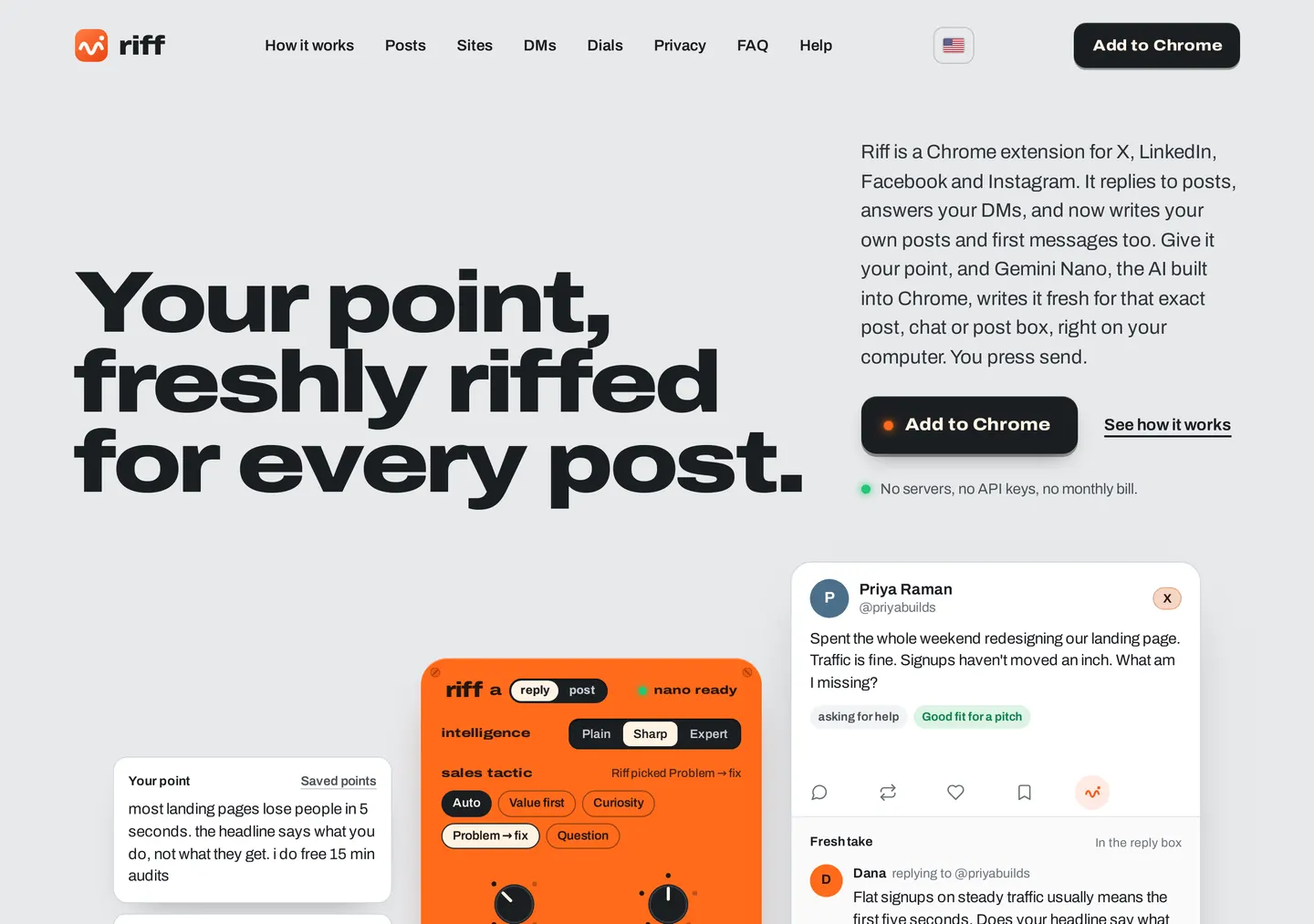
The most honest privacy policy I have read this month belongs to a reply bot. Riff is a Chrome extension that writes replies for X, LinkedIn, Facebook and Instagram — paste your rough point, set three dials (smart, salesy, adventurous), and it drafts something fresh for that exact post. It also answers DMs, including in Slack and Teams on the web, and it is free. Not freemium. There is no account, no subscription, and no payment page to find.
The policy is honest because it splits the world in two. The marketing site runs Google Analytics, consent-gated for the EEA, UK and Switzerland — they say so in plain words. The extension itself "has no servers, analytics, ads or trackers, and loads no remote code." Your voice profile, saved points and history live in Chrome's extension storage. The post or DM conversation you picked is held in session storage and cleared when the tab closes. I have read a hundred "we take privacy seriously" pages; this one reads like it was written by the person who built the thing, because it probably was — the maker is Zima Media OÜ, a one-line entry in the Estonian register, Sepapaja tn 6, Tallinn.
The model is not theirs
Here is the part the catalog line can't tell you. Riff's entire AI is Gemini Nano, the small model Google ships inside Chrome itself. The extension never calls an API — it talks to Chrome's built-in Prompt API, the same on-device plumbing Google offers any web app. Chrome downloads the model once, on an unmetered connection, and after that Riff works offline. So the European-ness of this European AI tool is a shell: Estonian company, Estonian code, and an American model doing the actual writing, borrowed from the browser underneath it.
I think that trade is more interesting than a hosted "European AI" badge. The data boundary is genuinely good — your DMs and drafts never reach Zima Media, Google, or anyone, because there is no server to reach. But the boundary is enforced by Chrome, not by Riff. If Google's Prompt API changes, prices, or disappears, a free tool with no revenue and no server has no fallback plan to sell you. Sovereignty at the model layer is still sovereignty by permission; it is just that the permission now belongs to your browser vendor.
Free means your hardware pays
The other honest page is the requirements list. Riff needs desktop Chrome 138 or newer — no phones, no tablets — plus 22 GB of free disk on the drive holding your Chrome profile, and either a GPU with more than 4 GB of video memory or 16 GB of RAM and four CPU cores. The "no monthly bill" is true because there is no meter: the compute bill moved to your machine, paid once in disk space and silicon. On a thin laptop this extension is not free at all; it simply declines to install.
What you get for that is a side panel that follows whichever post or chat box you open. In a DM you can leave the point empty and it answers what was written. Insert fills the reply box; pressing send is still yours, which also keeps you inside the platforms' automation rules. Replies write in English, Spanish, German and French.
Whether a free extension from a tiny OÜ keeps up with Chrome's moving Prompt API is the question I cannot answer from the outside. But the shape is right for what it is: a European shell, Google's model, your silicon — and a privacy policy that tells you exactly which of the three is doing what.
Find your next European tool
Browse a curated directory of software made in Europe across every category your team relies on.
Explore the directory
