Five of This Week's New Listings Are One Company
A Hungarian invoicing tool, a Hungarian booking site, a Hungarian company register, a Slovak company register and a Slovak PDF signer all joined the catalog this week. They are all Verde Holding Kft. of Balatonalmádi, which says it runs 41 products. I signed a PDF on one of them and watched the network tab.
Inês Valente
Journal editor, Lisbon

The Journal · Made in Europe
Twelve listings went into the catalog on 15 October, and a thirteenth the day after. Five of them looked unrelated: a Hungarian online invoicing tool, a Hungarian appointment booker, a Hungarian business-data platform, a Slovak company lookup, a Slovak PDF signer. Different countries, different jobs. The footers tell another story. Every one links back to verdeholding.hu.
Verde Holding Kft. is a company in Balatonalmádi, on the north shore of Lake Balaton. Its own site describes a fleet of 41 products: accommodation and restaurant software, online invoicing, appointment booking, and company-data lookups in Hungary, Slovakia, Estonia, Latvia and Lithuania, plus premium Balaton villas. The pattern is one stack, reskinned per country and per job. Bizonylat invoices to NAV, the Hungarian tax authority. Idopontok books appointments for salons and clinics. Felho.hu and Overit sell company lookups on either side of the same border. Podpisat signs PDFs.
The catalog now lists Bizonylat, idopontok.hu, felho.hu, Overit and Podpisat as five separate entries, which is correct — they are five separate products. What the cards cannot show is that they come out of the same workshop.
The document stays. The pageview does not
Podpisat's pitch is the strongest of the five: upload a PDF, draw or type a signature, place it, download. Free, no registration, and — its words — your document never leaves your device. On a signer, that is the whole game. DocuSign and its European challengers all hold the file on somebody's server while the signatures attach. A tool that never holds the file is a different product.
So I checked. This morning I opened podpisat.sk/podpisat-dokument, uploaded a one-page test PDF, drew a signature with the mouse and downloaded the signed file, with the network tab open. The only fetch after the upload was pdf.worker.min.mjs, the PDF.js renderer coming down to the browser. Nothing went up. No POST, no beacon carrying the file, no upload endpoint hiding behind a friendly name. The claim holds: the document stays in the tab.
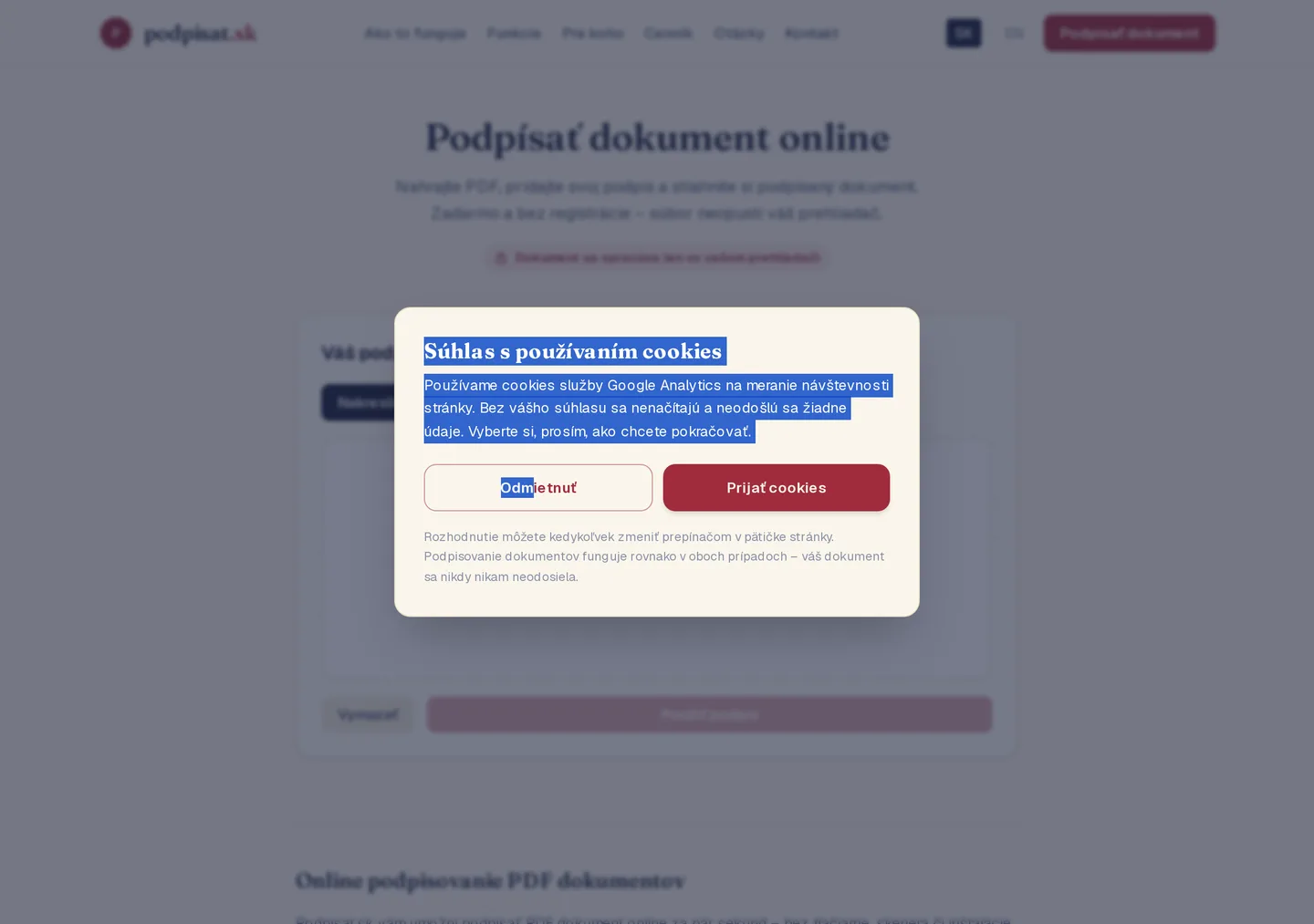
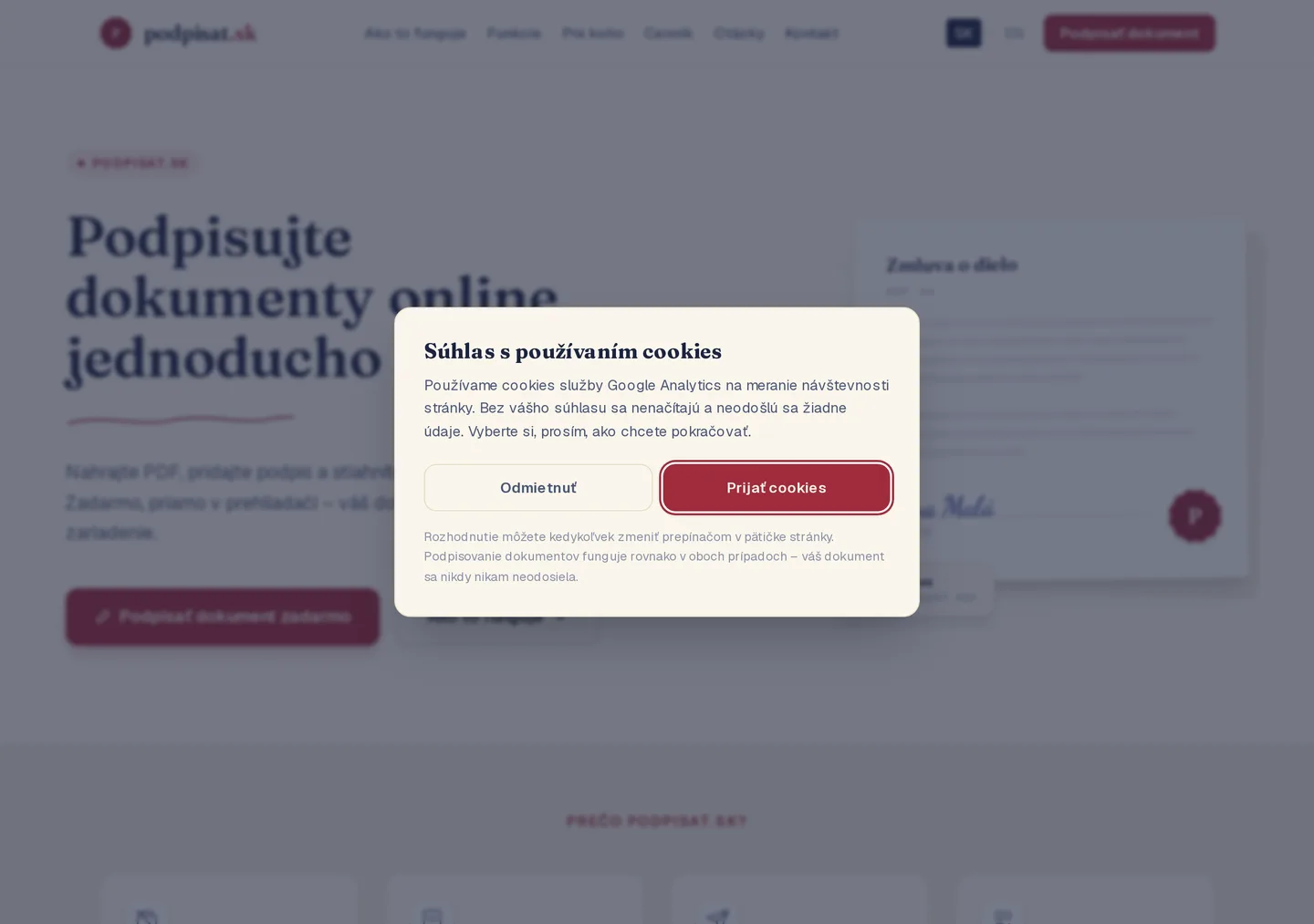
The page around the document is busier. On every page load, before you touch anything, the site posts a hit to verdeholding-api.fly.dev — the holding's own analytics, hosted on Fly.io, a US platform. Cloudflare's Web Analytics beacon fires alongside it. A Google Analytics tag ships in the bundle too, but it sits behind a gate: the site sets ga-disable until you press Accept cookies, which the cookie bar honestly labels as off by default. So the document never leaves your device, and three collectors know you were there. Two of them without asking.
To be fair to the Verde tracker: I read the script it serves. It sends no cookies and no persistent identifier, trims the referrer to origin and path, and only forwards an allowlist of campaign parameters. As trackers go it is one of the polite ones. But polite is a courtesy, not an architecture, and it still terminates on a Fly.io box. A signer that advertises nothing leaves your device should expect this question.
A house style, already visible
You can see the fleet's habits in the small print. Podpisat's FAQ is unusually straight about eIDAS: a drawn signature is a simple electronic signature, admissible for ordinary contracts only if the parties agree to that form, and for anything requiring a qualified signature you need a qualified certificate. Most signing tools bury that sentence. This one prints it on the homepage.
Then there is the contact form, which carries a note I have never seen a competitor publish: it is not connected to email yet, sent messages do not arrive, they are working on it. And the pricing page is a single free tier, with team plans marked as in preparation. The whole site reads like week three of a product, because it probably is — a holding with 41 SKUs does not polish each one before shipping.
That is the trade the fleet makes. Forty-one products means each one gets a shared stack, a shared tracker, a shared design language and a thin layer of country paint — Slovak on .sk, Hungarian on .hu, the same Verde beacon underneath. The result is shipping speed and honest localisation, at the cost of depth. Podpisat does one thing and does it correctly, which is more than the average e-sign clone manages, and it costs nothing. But when the paid tiers land, the question worth asking is whether the holding maintains forty-one products or just counts them.
If the job is signing a PDF without handing it to anyone's server, start with the listing and open the signer. Watch the cookie bar before you accept it. And if you ever wondered how one lakeside office ends up in five corners of a catalog at once — now you know to read the footer.
Find your next European tool
Browse a curated directory of software made in Europe across every category your team relies on.
Explore the directory
