Scalingo starts billing when the trial ends
A trial needs a card. One app, five S or M containers. When the thirty days are up, the resources keep running and the invoice starts. They do not delete the app for you. HDS is a create-time flag: existing resources cannot be converted later.
The EuroMakers Editorial Team
Researching European software

The Scalingo trial page does not end with a powered-off dyno. It tells you to delete the app yourself.
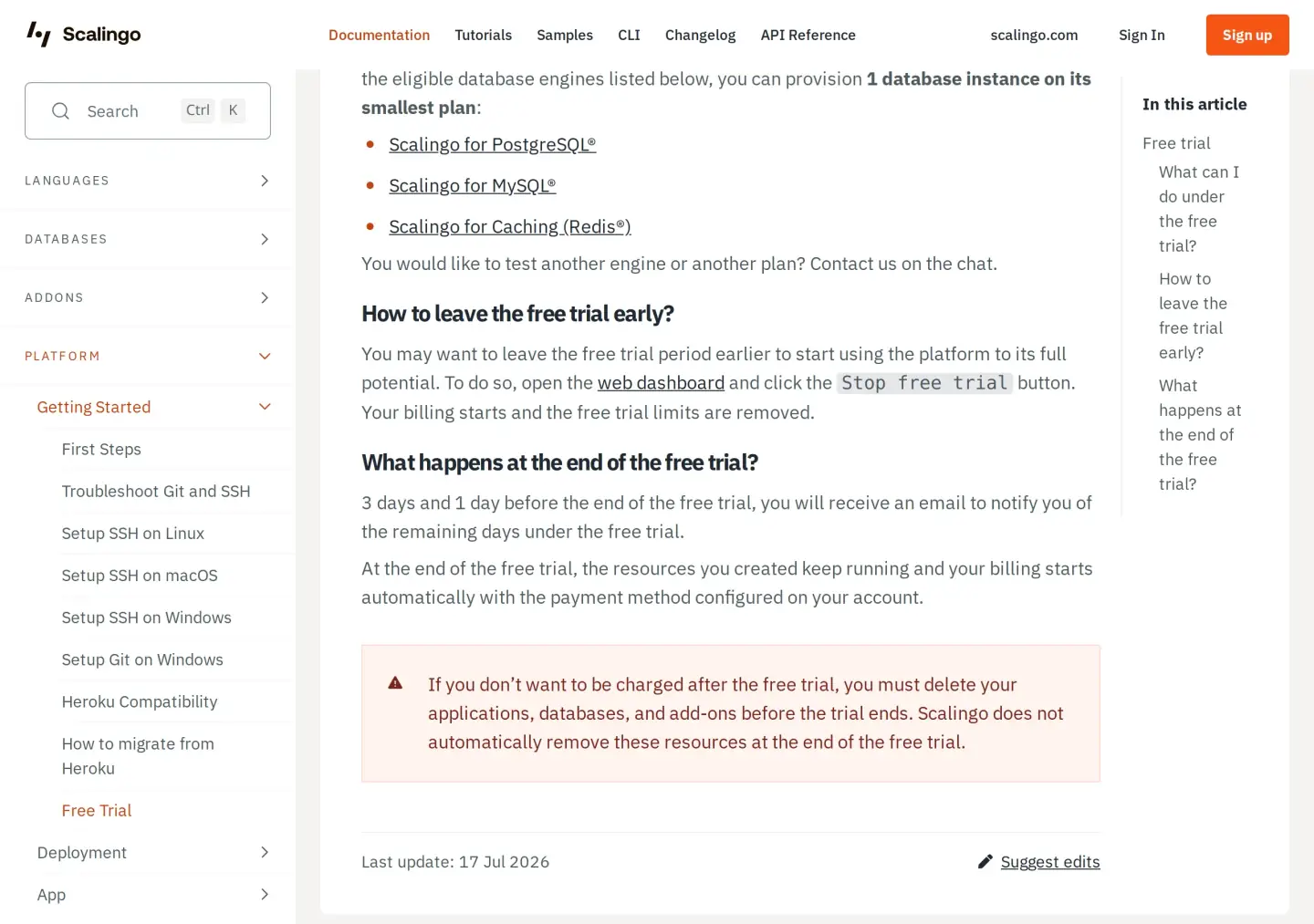
If you don’t want to be charged after the free trial, you must delete your applications, databases, and add-ons before the trial ends. Scalingo does not automatically remove these resources at the end of the free trial.
— doc.scalingo.com/platform/getting-started/free-trial, last updated 17 July 2026
Three days before, an email. One day before, another. Then the containers keep running and the payment method you had to add to start is billed. Leave early with Stop free trial and billing starts the same day. That is the meter. Not a sleep schedule.
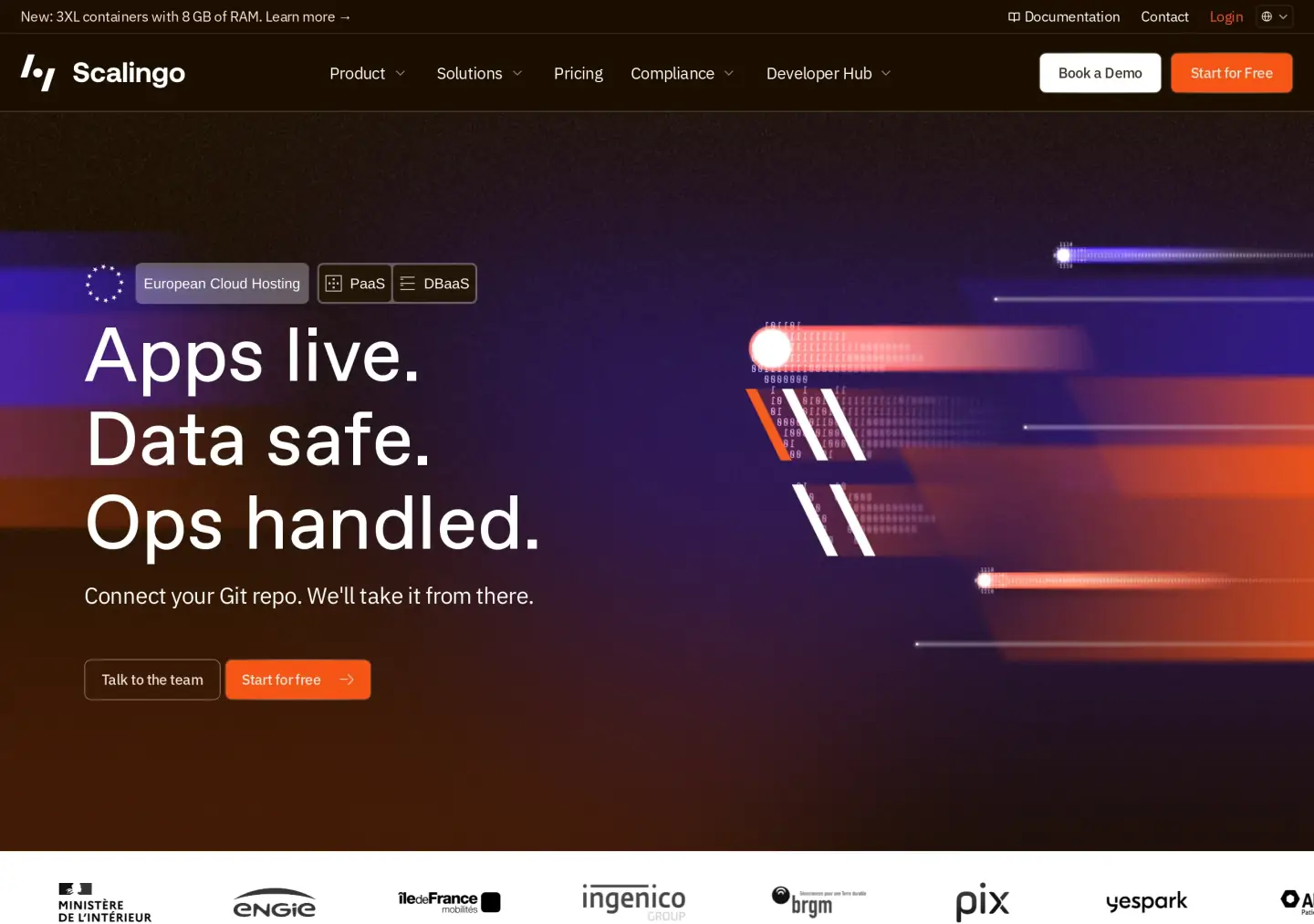
Scalingo SAS in Strasbourg ships a git-push PaaS and managed databases on French soil. You connect a repo. They build, run, and keep the process up. The homepage line is the job: Connect your Git repo. We’ll take it from there. Not a VPS you still patch.
How you actually run it
Git and an SSH key. Dashboard, CLI, or Terraform. Push, they detect a buildpack, boot containers. Default size is M: 512 MB of RAM. Scale with scalingo --app my-app scale web:2:L. Horizontal scaling caps at 10 containers per process type unless support raises it. Review apps are extra applications, not a free preview slot.
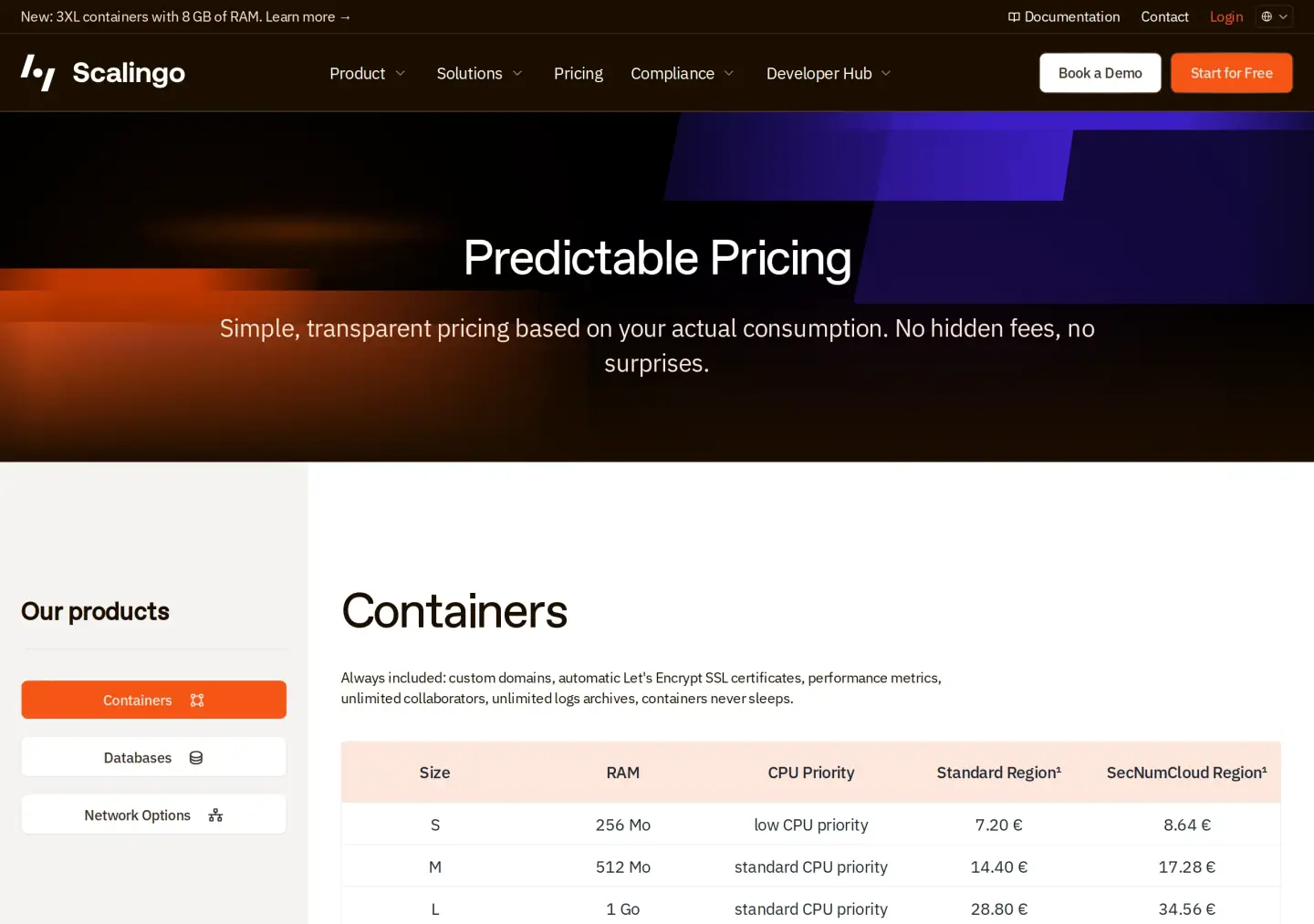
Containers do not sleep. Their pricing page, with the grammar they printed: containers never sleeps. Custom domains, Let’s Encrypt, metrics, unlimited collaborators, log archives, all on the same card. Autoscaling is extra running containers, billed like the rest, per minute. One-off runs, review apps, add-ons: same invoice at the start of the next month.
The trial is smaller than that. Docs, not the orange button:
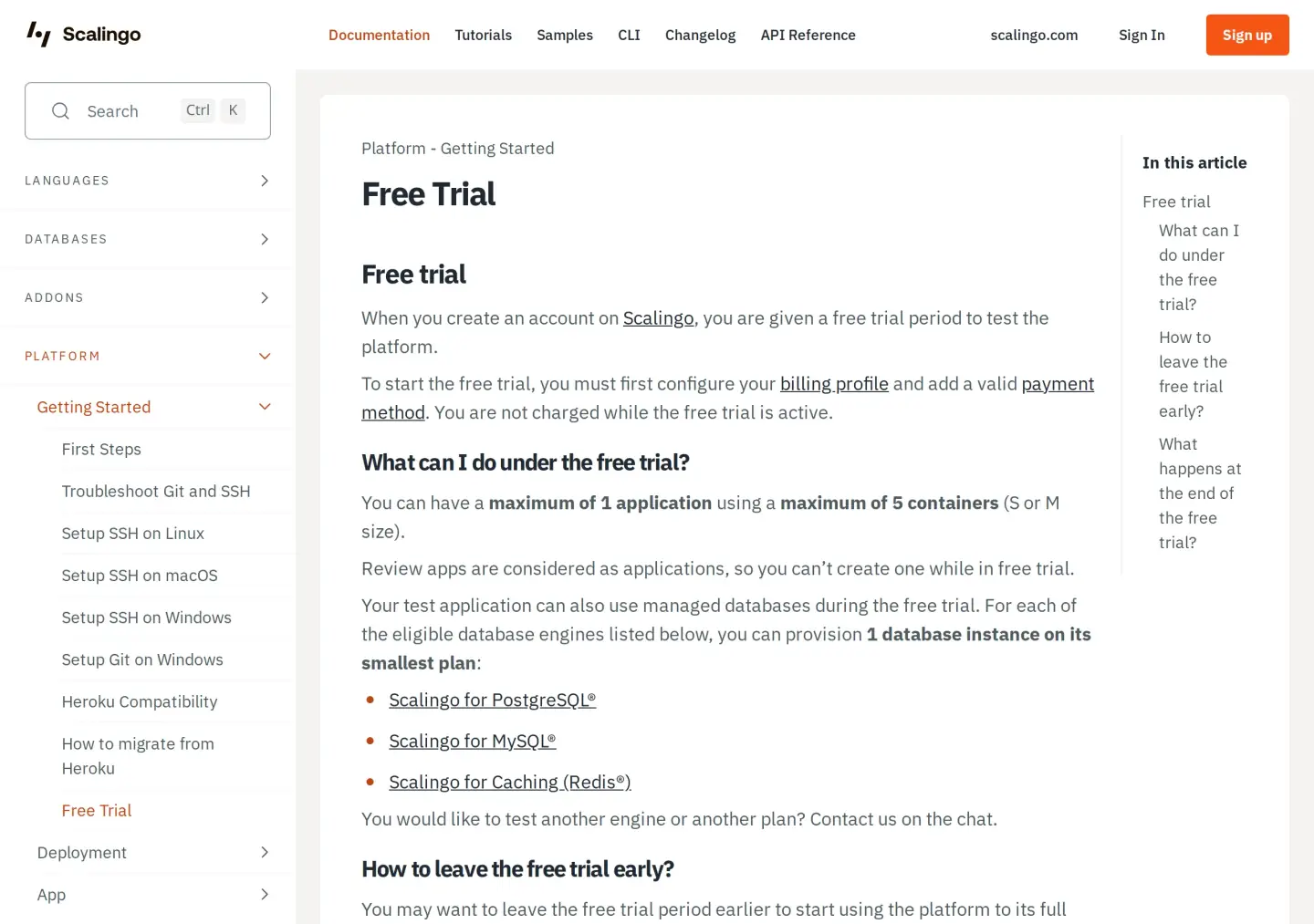
One application. Five containers, S or M only. One smallest Postgres, one MySQL, one Redis. Review apps count as apps, so you cannot spin one. The pricing FAQ is blunt about the card: they verify it. They charge at the end of the billing cycle. The trial page is the other half: you are not charged while the trial is active. After it, you are, unless you deleted the resources.
The shop in euros
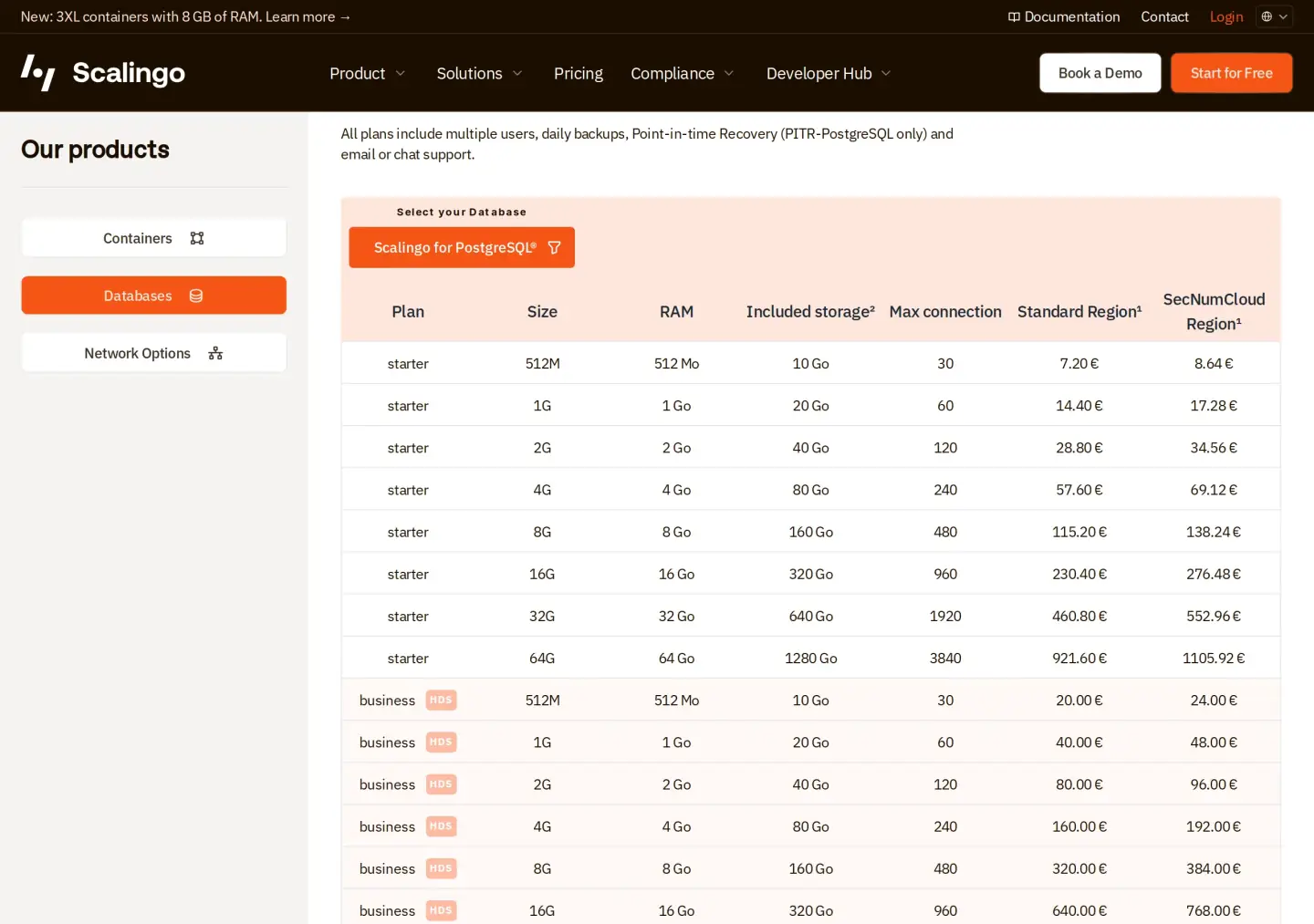
On 9 September the container table estimated 30 days, VAT excluded. S, 256 MB, low CPU priority: €7.20 in the standard region, €8.64 on SecNumCloud. M €14.40 / €17.28. L €28.80 / €34.56. XL €57.60 / €69.12. 2XL €115.20 / €138.24. 3XL, 8 GB, high CPU: €230.40 / €276.48. The 3XL size landed in the changelog on 21 July. The blog post is 27 July. Swap on that table is not a second RAM stick: S has 64 MB of swap, 3XL 2,048 MB, and the internals page says swap is being phased out.
Postgres on the same shop, still 9 September. Starter 512M: €7.20 standard, 98% SLA, single node, ten backups. Business HDS 512M: €20.00, 99.96% SLA, multi-node. PITR is PostgreSQL only. Payments: Visa, Mastercard, American Express, PayPal, SEPA. Billing is per minute, invoiced for the month that just ended.
HDS is a create-time flag
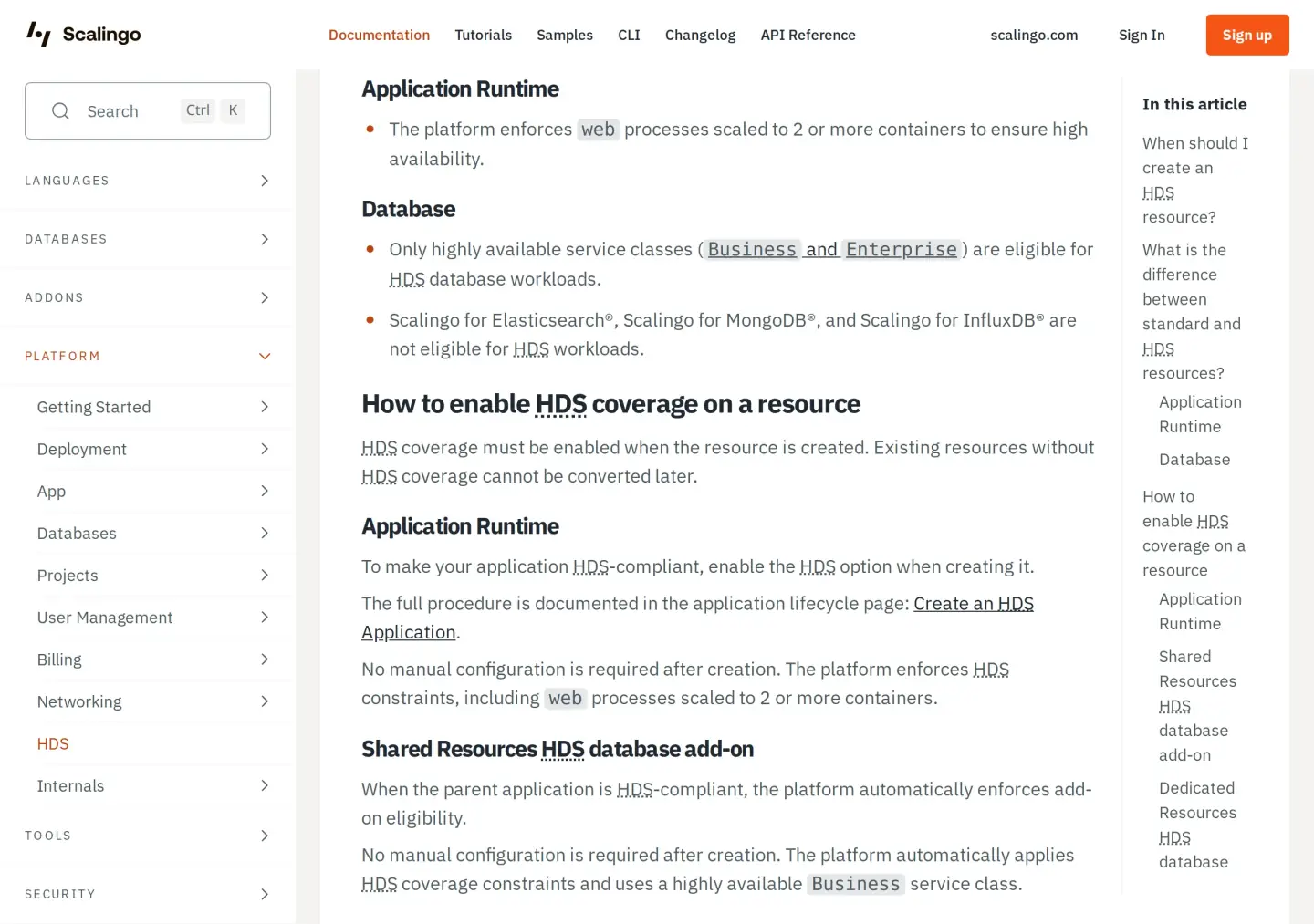
The shop FAQ says there is no extra fee for HDS certification on equivalent hardware. Then the constraint: Business or Enterprise, and at least two web containers. Starter is not eligible. Elasticsearch, MongoDB, and InfluxDB are not eligible at all. Their docs, last updated 26 February:
HDS coverage must be enabled when the resource is created. Existing resources without HDS coverage cannot be converted later.
— doc.scalingo.com/platform/hds, last updated 26 February 2026
Who should not start here. Anyone who thought Start for free meant no card, and that silence after day 30 would idle the process. Anyone who needs HDS on an app they already created without the flag. Anyone putting health data in Mongo, Elasticsearch, or Influx on this platform. Anyone who is not a company or public body and wants osc-secnum-fr1. Anyone whose cost model is Heroku Eco: these containers do not sleep. Anyone who needs the Enterprise database class without asking; that tier is selected customers only. Anyone who needs a US region: there isn’t one on the table.
If the job is git-push hosting that stays in France, start with the listing, then Pricing, then Free trial. Look for does not automatically remove. A trial that needs a card is not a trial that powers off.
New to the EuroMakers Journal? Start with how the Journal works.
Find your next European tool
Every product in the directory is reviewed by a person and shows where it’s made. Start with a tool you use today.
Explore the directory
