The TV OS that pays the TV maker
Titan OS, a Barcelona company, raised $46 million yesterday — partly as a BlackRock credit facility. It now runs on every 2026 Philips television, where Google TV used to be. Philips did not switch for the features. It switched for the ad revenue.
Inês Valente
Journal editor, Lisbon

Yesterday Titan Operating System S.L., a Barcelona company most people have never heard of, announced $46 million in new funding. Equity from existing investors Highland Europe and Mangrove Capital Partners, plus a credit facility from funds managed by BlackRock. Total raised: $110 million. The company describes itself as a 'technology, entertainment and advertising company' — keep that word order in mind, because it is the whole story.
Titan OS is the operating system inside every Philips television sold this year. Not the budget models — all of them, including the flagship OLED 8 and 9 series that used to run Google TV. TP Vision, the company that owns the Philips TV business, announced the switch at its Berlin launch event in March. If you bought a 2026 Ambilight, this is what you got instead of Google.
The reasons were unusually candid. Philips developer Danny Tack told c't that dropping Google TV saves licence fees and lets TP Vision earn advertising revenue — ads on the home screen, ad-funded FAST channels, and viewing data from automatic content recognition, the frame-matching that reports back what is on your screen. Reviewers were less polite about the trade: FlatpanelsHD noted that TP Vision 'can provide input that steers the development' and gets a bigger cut of ad revenue, while the sets lost Google Cast entirely. AirPlay survives; an Android owner casting to a 2026 Philips needs a third-party app. The first Titan models also shipped without MagentaTV and Disney+. You do not choose the OS on a television. The manufacturer chooses it, and this one was chosen because it pays.
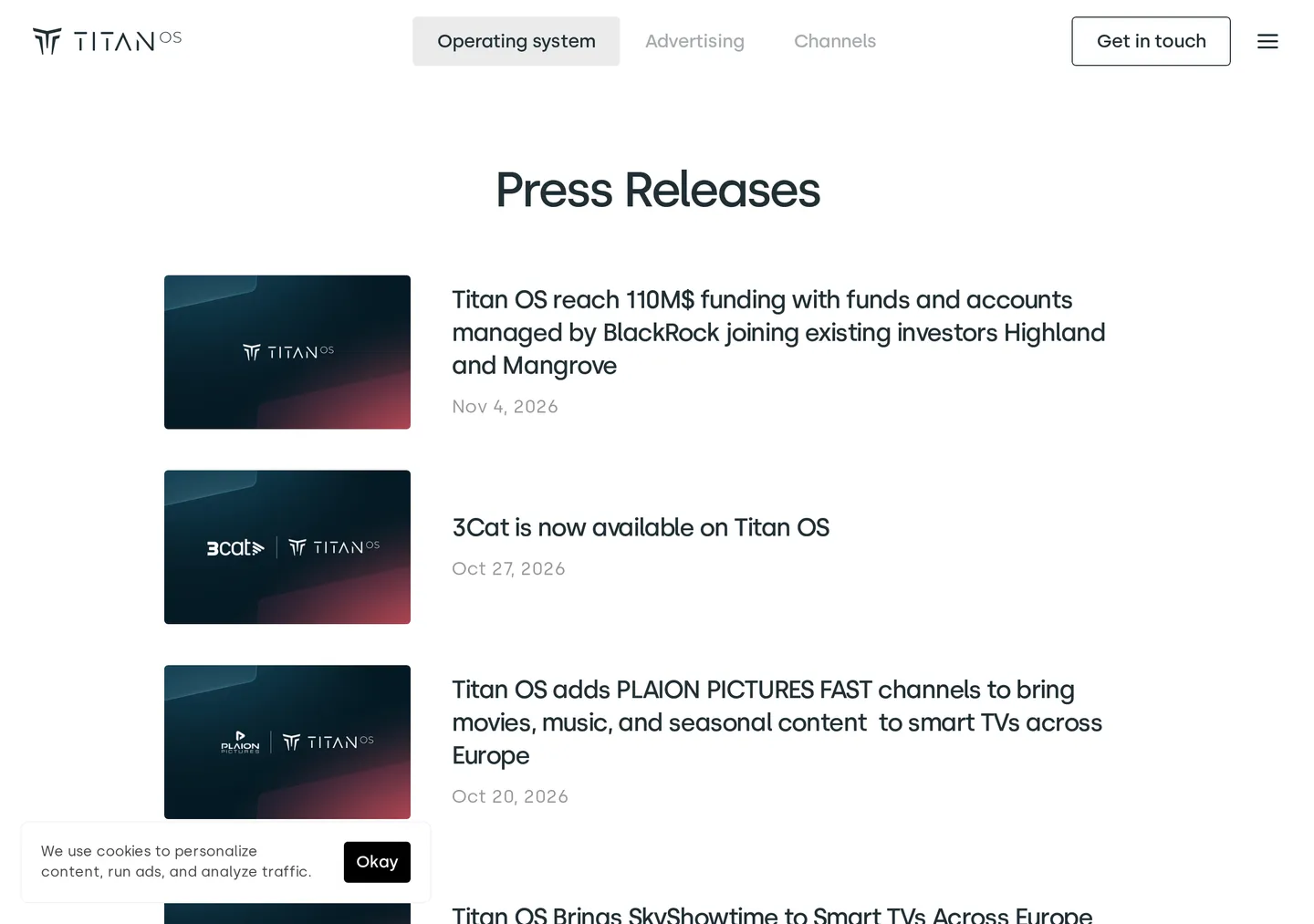
To see what Titan OS actually sells, read its own press release archive. In the last year it has announced more than twenty FAST channel launches — those free, ad-supported streaming channels that sit in the TV guide like regular channels. In May it launched what it called industry-first programmatic video ads on the home screen itself, with ad-tech firm Equativ. In November 2025 it partnered with MiQ to offer advertisers 'OS-level TV intelligence'. And its Titan Ads unit does not even need Titan OS: since October 2025 it has been the monetisation partner for the rival TiVo OS across Europe. The operating system is the container. The inventory is the product.
Thirty million screens, and counting
The numbers explain the round. Titan says it reaches 30 million users, up from 18 million a year ago, that revenue has grown fifteen-fold in three years, and that its OS is licensed to Philips, JVC, Vestel, Skyworth, Sharp and AOC — Vestel alone builds sets for dozens of supermarket brands you would not recognise as Vestel. Headcount is around 250, with offices in Barcelona, Amsterdam and Taipei, and a new London office dedicated to advertising. Founder Jacinto Roca built Wuaki.tv, the Spanish streaming service Rakuten bought, and the founding team has been assembling this supply chain since 2023.
The money's shape matters too. Part of this round is not equity but a credit facility — debt — from BlackRock-managed funds. Lenders do not take a punt on a vision; they lend against a cash flow they can model. The cash flow here is thirty million European home screens sold as ad inventory, with viewing behaviour attached by ACR. There is a reason a smart TV costs less than the panel inside it used to.
I do not think the answer is pretending the trade does not exist — Google's TV business runs on the same fuel, only bigger. But the next time a review praises a European OS for being 'lighter' or 'independent', it is worth asking independent of what. Titan OS is independent of Google. It is not independent of advertising; advertising is the revenue line, and now it is also the collateral. When I shop for a television I check the panel type and the ports. After this week I will also ask who gets paid when the home screen lights up.
Sources, all read 5 November 2026: Titan OS's press release on the $46 million round and its archive of channel and ad-product launches, TechCrunch's report for the headcount, London office and TiVo partnership, heise for Danny Tack's comments on licence fees, home-screen ads, FAST and ACR, and FlatpanelsHD on the lost Google Cast and missing apps. The user and revenue figures are company-reported; I could not verify them independently. Titan OS is not in our directory.
Find your next European tool
Every product in the directory is checked before it goes live and shows where it’s made. Start with a tool you use today.
Explore the directory
