Databaas Keeps Your Data in Your Own Bucket
Wolk, a thirteen-person consultancy in Utrecht, launched Databaas on 20 October as Europe's answer to Snowflake and Databricks. The product is a managed bundle of open-source tools deployed wherever you choose — and the exit is part of the architecture.
Inês Valente
Journal editor, Lisbon

The Journal · Made in Europe
The press release went out from Utrecht on 20 October: Wolk, a Dutch data consultancy, is launching Databaas, "the first Dutch managed data and AI platform that organisations can run wherever they choose." First customer already signed — Infoplaza, the weather company whose forecasts route ships, trains and gritting trucks, is moving its data operations off the American hyperscalers onto it. Europe's answer to Snowflake and Databricks has a name, a customer, and a ship date. The ship date is Q1 2027.
Wolk is a thirteen-person company founded in 2023 by four former Lightyear engineers — Lightyear being the Dutch solar-car startup that went bankrupt in 2023, which is where a lot of good engineers washed up. Since then they have been building bespoke data platforms on open-source components for clients like Deltares and Next Kraftwerke. Databaas is that consultancy work turned into a product: the same stack they kept assembling by hand, now sold as one managed thing.
Read the parts list, not the slogan
The platform page is refreshingly unglamorous about what you are buying. There is no proprietary engine in it. Pipelines are Apache Airflow. Storage is Apache Iceberg tables catalogued by Lakekeeper on S3-compatible object storage — your bucket, not theirs. Query is Trino. Dashboards are Apache Superset, notebooks are JupyterHub plus Marimo, single sign-on is Zitadel. Wolk wires it together, operates it, handles upgrades, and sends one bill.
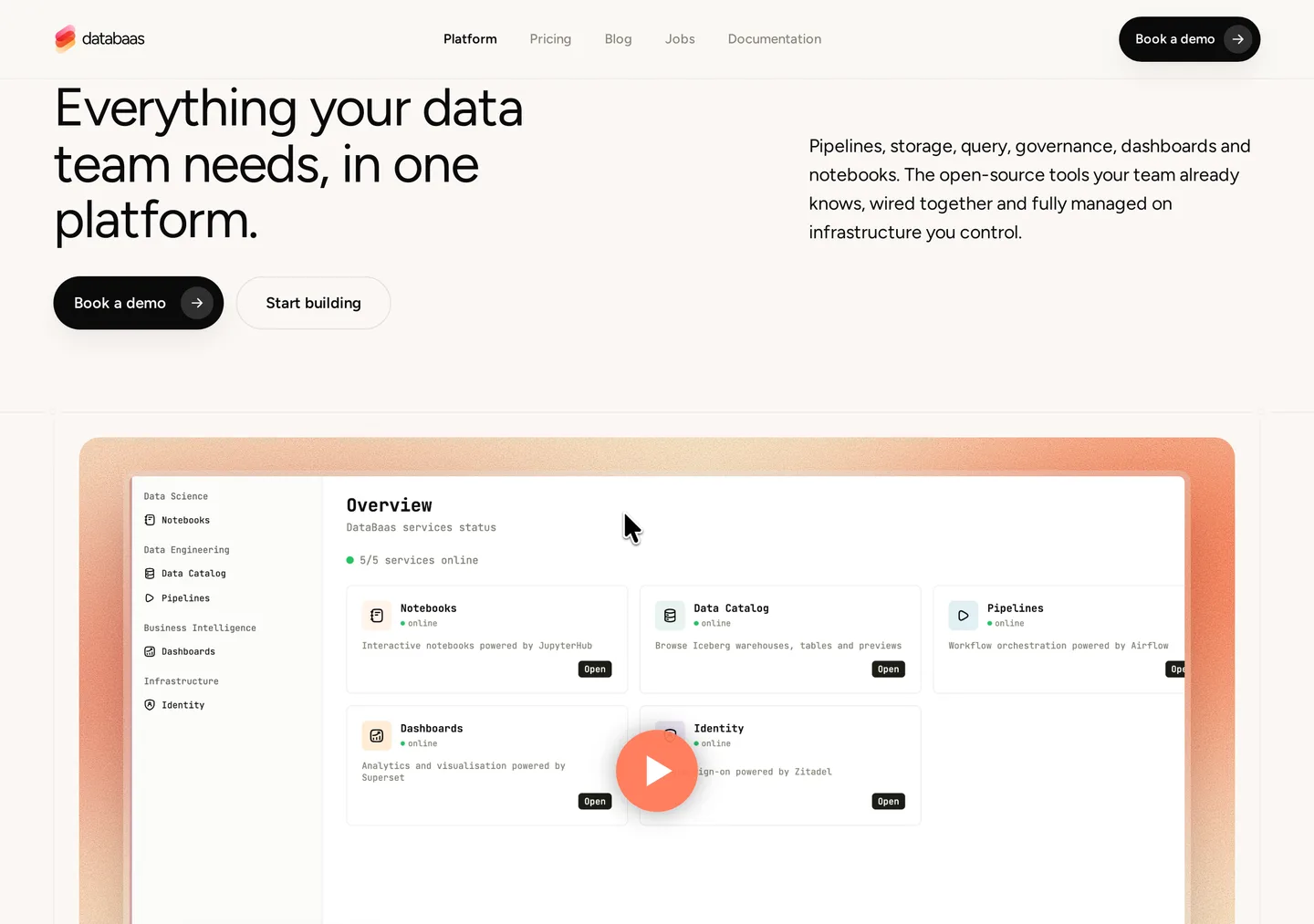
That is the detail the catalog cannot show you, and it inverts the usual lock-in arithmetic. Snowflake's business model works because your data lives inside Snowflake, in Snowflake's formats, on Snowflake's chosen clouds. Databaas puts the Iceberg tables in a bucket you own, in a region you pick — EU infrastructure, a Dutch data centre, or your own hardware. If Wolk disappears or the bill doubles, the open formats mean you export the tables and the Airflow pipelines and hire someone else to run the same stack. The exit is not a contract clause. It is the architecture.
Their own metaphor is better than mine: co-founder Stijn Meijers says Europe laid brand-new railway tracks with its sovereign clouds, but everyone who wants to ride them first has to build their own train. Accurate, and also the honest version of the pitch — you are not buying a train either, you are paying Wolk to keep the off-the-shelf one running.
What "launch" means here
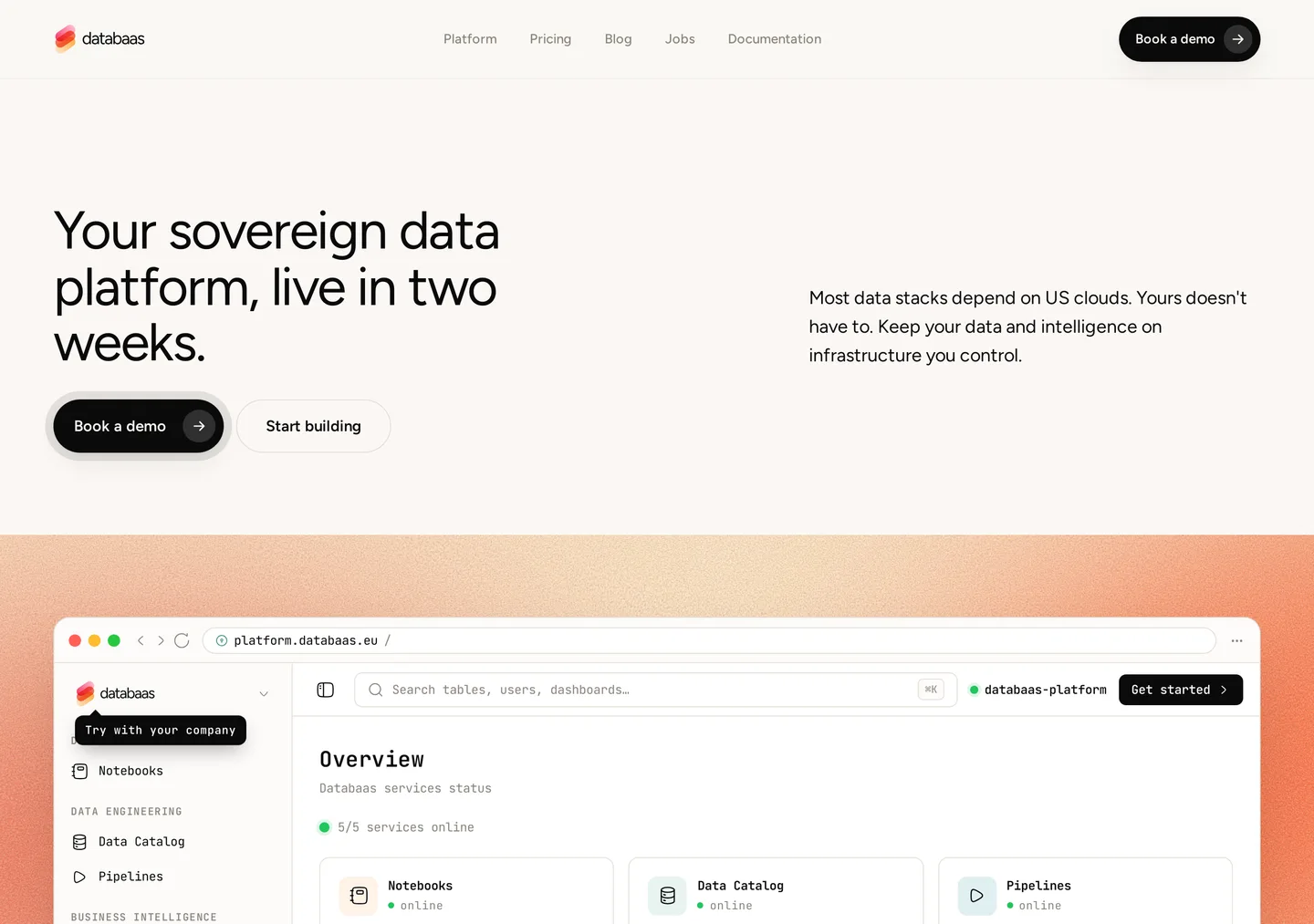
Worth being precise, because the announcement reads bigger than it is. Databaas is in private preview. Pricing is custom — book a demo, join the waitlist. New customers are onboarded from the first quarter of 2027. The site already promises "live in two weeks," but that clock starts after they let you in. So this week's news is real — a named platform, a named first customer, a real deployment off US clouds — and also a kickoff, not a product you can evaluate against Snowflake today.
I have one reservation, and it is the usual one for sovereignty pitches: managed open source still means a vendor in the middle. Zitadel, Trino and Superset are all downloadable tonight — a sufficiently staffed data team could build this themselves, which is precisely the project Wolk says costs organisations years. The bet Databaas is making is that most European organisations would rather pay a thirteen-person Utrecht team than keep a platform team on payroll. After a decade of watching that calculation, I would not bet against them.
Find your next European tool
Browse a curated directory of software made in Europe across every category your team relies on.
Explore the directory
