How to Choose a European Encrypted Messenger You Will Keep Opening
A practical guide to European pocket messengers — Threema and Olvid — based on how trust starts: a Swiss ID you buy once, or a French invitation that protects metadata, not only message bodies.
The EuroMakers Editorial Team
Researching European software

The Journal · Made in Europe
Most messenger shopping starts with a tired thumb. Another group chat. Another phone-number signup. Another app that knows your contacts before you have said hello. You want quieter private talk — and you end up installing something that still feels leased from someone else's address book.
In EuroMakers, that pocket seat lives in the Communication category. Threema is the Swiss messenger with a Threema ID and a one-time purchase. Olvid is the French messenger built around invitation-based trust and encryption that watches metadata, not only message bodies. They are siblings in the private-message job — not twins, and not stand-ins for team chat or meeting links.
Write the conversation you keep postponing
Skip the feature matrix for a minute. Write the sentence that describes this week.
- I want private chats without handing over my phone number — family, peers, or a sensitive side-channel.
- I want a Swiss-hosted messenger I can buy once, without ads or a growth funnel in the inbox.
- I want invitation-based trust and encryption that treats metadata as part of the secret.
- I keep shopping for a team suite when the real pain is a calm personal pocket.
If the friction is "my contacts graph is the product," you want a pocket messenger. If the friction is channels, Spaces, or guest rooms for a company, look at Element and Wire — different seats on the conversation shelf. Made in Europe is the quality bar either way: craft, restraint, and makers across the continent — not a rule that one vendor must own every ping.
Two European pockets, two trust crafts
Here is how the current listings differ when you ask how trust begins — and what stays quiet after you press send.
Threema — Swiss ID, one-time purchase
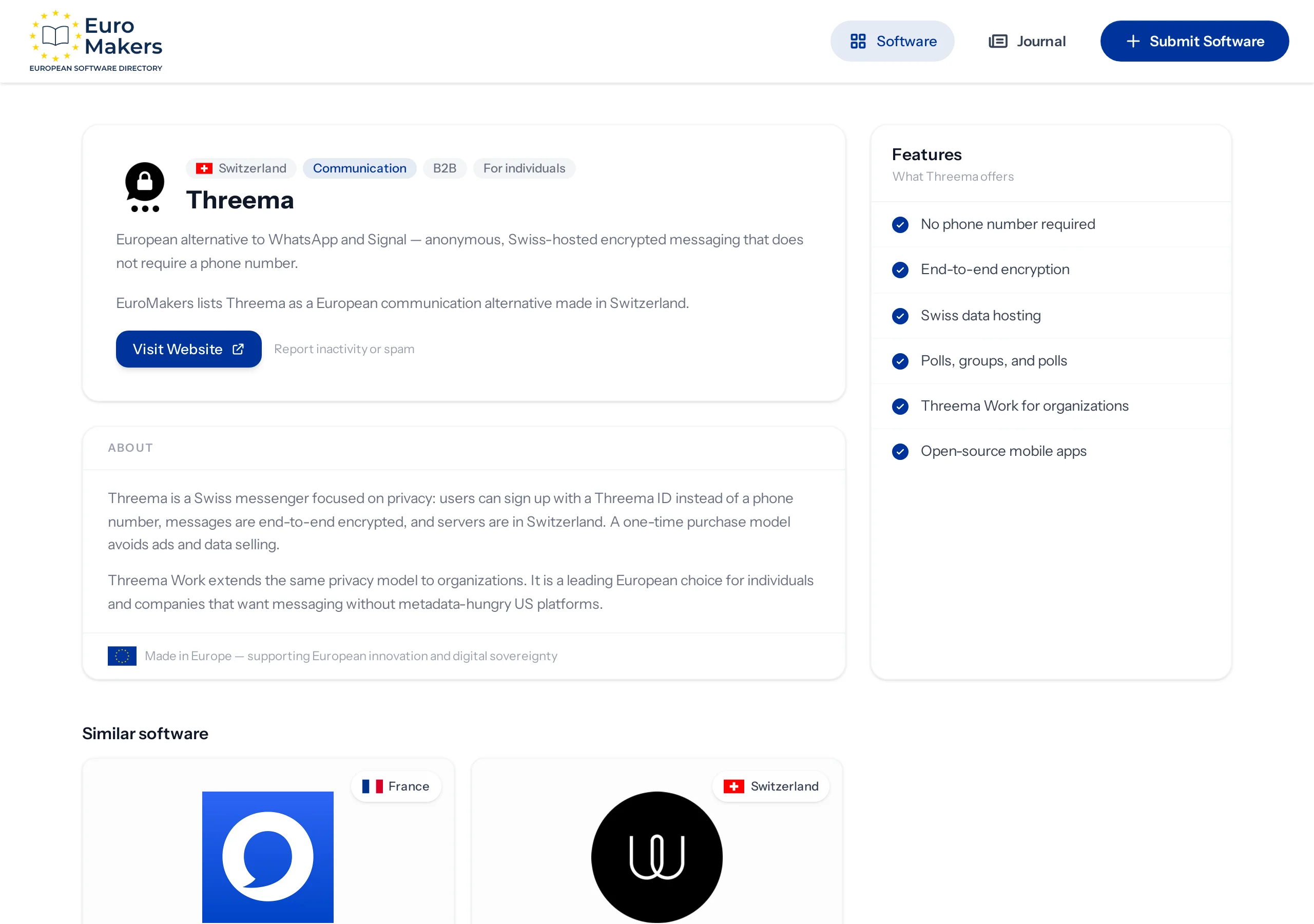
Threema, from Switzerland, is the European alternative to everyday consumer messengers that still demand a phone number. You sign up with a Threema ID, messages are end-to-end encrypted, servers sit in Switzerland, and a one-time purchase model skips ads and data selling. Open-source mobile apps, groups, and polls cover ordinary life. Threema Work extends the same posture to organisations that want a quieter house.
Choose Threema when the job is a durable personal pocket: no phone-number leash, Swiss hosting, and a product you pay for once instead of feeding with attention. It suits individuals and organisations who want encrypted chat that feels finished on Monday morning. If your pain is invitation-only trust with a stronger metadata story — or you want French-rooted professional chat — look at Olvid instead.
Olvid — French invitations, metadata in mind
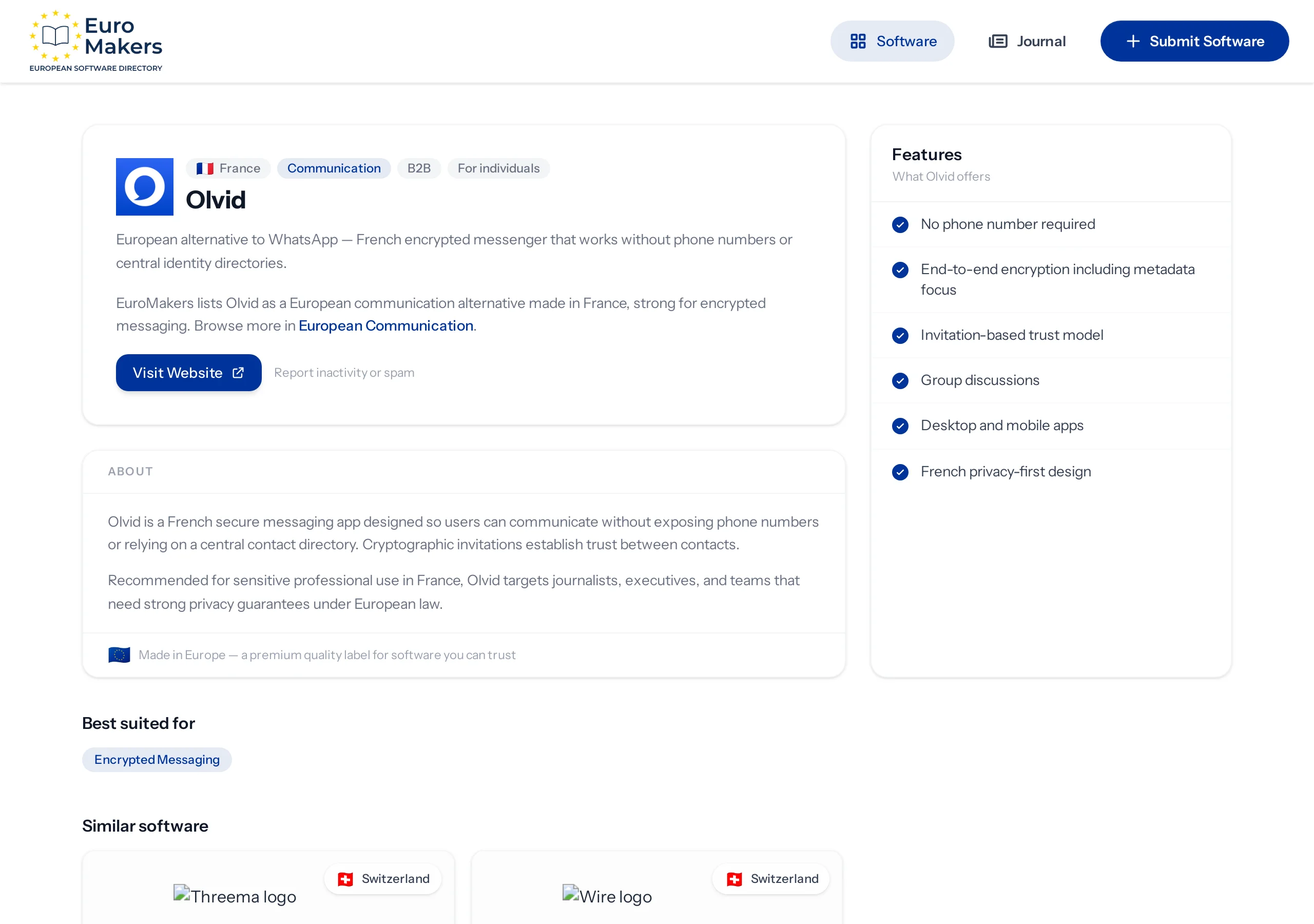
Olvid, from France, is built so you can talk without exposing a phone number or leaning on a central contact directory. Cryptographic invitations establish trust between contacts. End-to-end encryption includes a focus on metadata, not only message bodies. Group discussions plus desktop and mobile apps make it practical for sensitive professional use — people who need quieter talk for work, reporting, or careful one-to-ones.
Choose Olvid when the job is invitation-based trust and a messenger that treats who-you-talk-to as part of what must stay quiet. It suits readers leaving phone-number graphs who want a French craft with a clear professional spine. If you mainly want a Swiss ID you can buy once for family and everyday groups, start with Threema.
A shortlist by how trust should begin
- You want a Swiss ID, no phone number, and a one-time purchase without ads → start with Threema.
- You want invitation-based trust and encryption that watches metadata → try Olvid.
- You need organisational rollout with the same Swiss hosting model → look at Threema Work after a personal trial of Threema.
- You actually need team channels, federation, or guest rooms → stop — that is Element or Wire, not a pocket messenger stretched thin.
Switzerland specialises in a paid, ID-based pocket with organisational reach. France specialises in invitation trust and metadata craft. That spread is the point of a healthy European market — not two logos fighting over the same sentence.
How to trial without stranding your contacts
Messenger swaps fail when people announce a big migration and abandon the old app on day two. Keep the first fortnight reversible.
- Pick one trust craft: Swiss ID purchase, or French invitation path.
- Install mobile and desktop before you invite anyone important.
- Move one small group first — family, a peer circle, or a sensitive work duo — and use only that thread for ten days.
- Test the boring moments: a voice note, a group poll, offline reopen, a contact invite, and a device switch.
- Only then widen the circle, set recovery habits, and retire the old pocket for that job.
Where Made in Europe feels premium
Made in Europe matters in messaging when it shows up as craft: signup without a phone-number leash, encryption that is default, and products that treat conversation as something worth protecting — not as another growth funnel. It is a premium quality label when the app feels built for people who talk carefully, not loudly.
There is also a quiet unity story here. A Swiss ID pocket and a French invitation messenger can sit in the same week without pretending to be the same product. European software is often strongest when countries specialise — and when you keep sibling seats clear instead of stacking four apps that fight for the same ping.
Choose the messenger that matches how trust begins, not the one with the loudest feature list.
— EuroMakers Journal
Start here
Open the Communication category, read Threema and Olvid, and run one careful fortnight with a small circle. If team rooms or meeting links are next instead, keep the shelf clear with our conversation shelf essay. Building a wider European stack? Browse the directory or keep reading the Journal. Missing a European messenger we should know about? Tell us.
Find your next European tool
Browse a curated directory of software made in Europe across every category your team relies on.
Explore the directory
