Supportifier answers only what you reviewed
Supportifier, a Swedish helpdesk from Successifier AB in Älta, inverts the usual support-AI deal: its agents answer only what your team has already reviewed, and say so when the source has no answer. The price floor is SEK 79,000 a year, quoted per arrangement — the knowledge work is billed as the product, not the seats.
Inês Valente
Journal editor, Lisbon

The submission that landed in our queue on 24 October pointed, unusually, at a security page. Most makers send their homepage and let the marketing do the talking; Supportifier sent `/en/security`, the page where it explains that customer tickets are never used for model training and that its language model runs with zero data retention. I read the homepage anyway. The first line on it is the whole product: "Let AI agents answer. Without guessing."
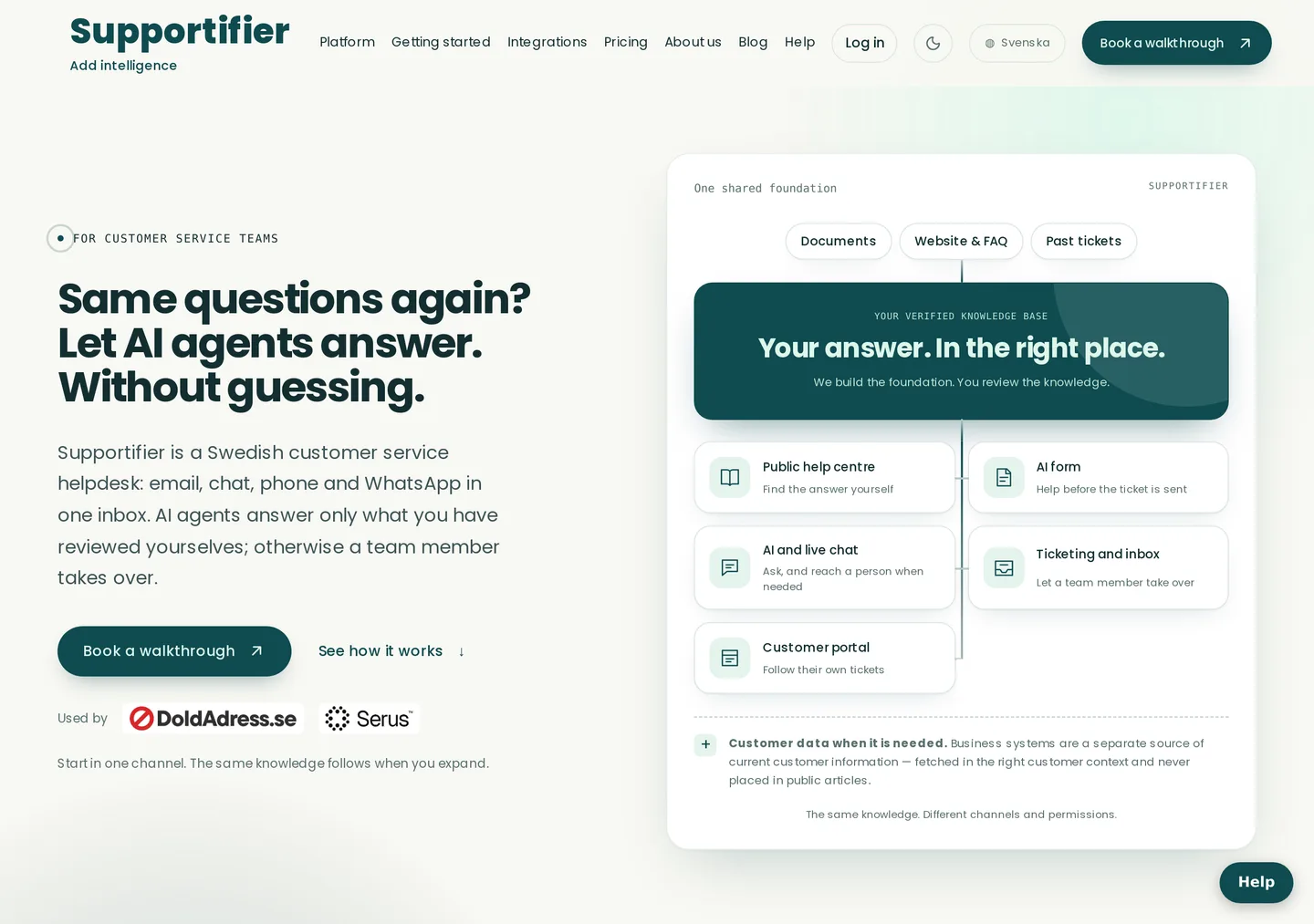
Supportifier is a helpdesk built by Successifier AB in Älta, south of Stockholm. Email, chat, forms, phone, WhatsApp, Messenger and Instagram land in one shared inbox — that much is table stakes, and Zendesk will sell you the same sentence. The difference is the order of operations. The standard pitch for support AI is that the model drafts and a human approves; Supportifier runs it backwards. During onboarding the company builds a knowledge base with you out of your documents, your site and FAQ, and your past tickets. Your team reviews what should apply. From then on the AI answers only from that reviewed material, checks each answer against the source before the customer sees it, and when the source has no answer it says so and hands the conversation to a person. Every channel — the public help centre, the pre-ticket AI form, the live chat, the team inbox, the customer portal — reads from the same reviewed knowledge, so an answer corrected once is corrected everywhere.
It does things, not just says things
The agents are not confined to reciting policy. Connected to a shop, they can cancel orders, issue refunds and change delivery addresses in Shopify, WooCommerce and Magento, book returns in Shopify, and write credit memos in Business Central. The security page draws the line where you would want it drawn: business systems are a separate source of current customer data, fetched in the right customer context and never written into public articles. Who can see what is decided per channel, sign-in is SSO restricted to your own domain, and customers are separated at the database level.
Underneath sits a language model from Anthropic — they name the provider, which is rarer than it should be — run with zero data retention, so ticket content is processed for the answer and not kept by Anthropic afterwards. Approved answers improve suggestions inside your own account only; nothing is pooled across customers. Storage is EU/EEA, a data processing agreement is signed with every customer as standard, and retention periods live in the contract rather than a settings page. The one honest wrinkle: the marketing site's own visitor statistics go to Google, OpenAI and Apollo after consent. A company whose product sends nothing anywhere still runs analytics on its brochure, and says so in the same paragraph.
The price is the thesis
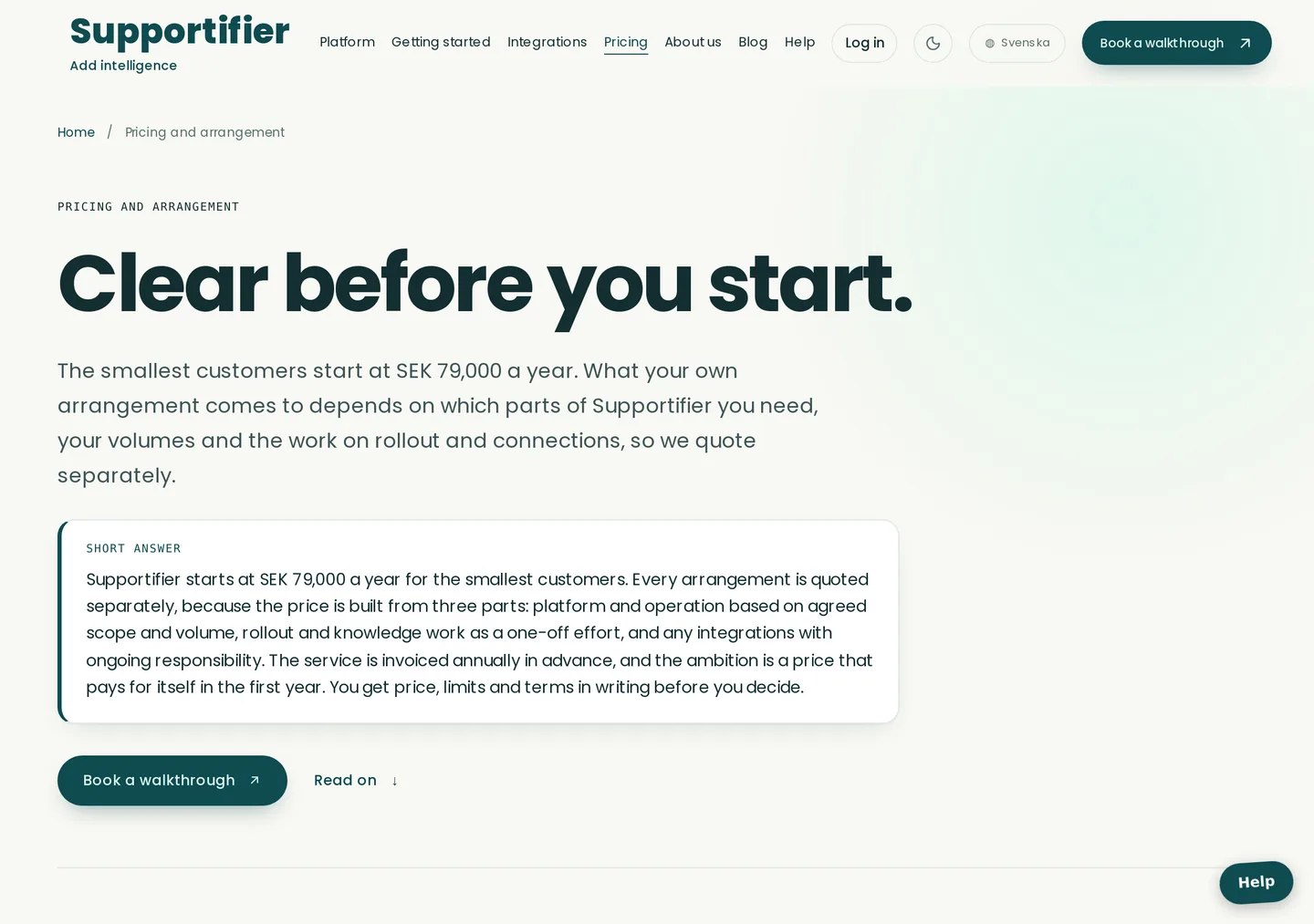
Here is where Supportifier stops sounding like a tool and starts sounding like a position. The smallest customers start at SEK 79,000 a year — roughly €7,000 — invoiced annually in advance. There is no per-seat table, no self-serve tier, no free trial with a greyed-out export button. Every arrangement is quoted separately and split into three parts the pricing page insists you keep separate: platform and operation priced on agreed channels and volume, rollout and knowledge work as a specified one-off, and integrations with ongoing responsibility. The stated ambition is a price that pays for itself in the first year, and the page tells you what to bring to the first conversation: an approximate ticket volume, a headcount, your channels and the systems support already uses.
Read the founders and the price makes sense. Rickard Collander ran customer service for nearly twenty years — Bonnier Magazines, Telia's outsourced operation, CCO of the contact-centre company Releasy, most recently Head of Customer Success at Scania. Martin Carlsson spent fourteen years at Länsförsäkringar Gävleborg running a customer service unit, then business development and IT. These are operators, not ML researchers, and the product is what operators build when they have watched a chatbot apologise confidently to a customer about a refund policy it invented. The knowledge work — extracting, structuring, reviewing — is billed as a named line item because it is the part that determines whether the automation is worth having. An AI that only repeats what you approved is only as good as the review, and Supportifier charges for the review.
Whether the bet works depends on a claim I cannot check from here: that the reviewed base stays right at ticket volumes and catalogue churn a real e-commerce team produces. SEK 79,000 is a serious floor for an SME — it prices out the curious and presumes the alternative costs more, which is true only if unanswered and mis-answered tickets are actually costing you seven grand a year. But I will take a pricing page that names its floor in writing over a "contact us" wall with no number at all. Supportifier joined the directory this week; the listing is at /software/supportifier if you want the short version.
Find your next European tool
Every product in the directory is reviewed by a person and shows where it’s made. Start with a tool you use today.
Explore the directory
