How to choose European AI tools for the craft you actually run
A practical guide to European AI software — DeepL, Hugging Face, PhotoRoom, Aleph Alpha, Dataiku, Cognigy, Black Forest Labs, poolside, Melious, and Vibe — based on the craft you need: language, an open model hub, product photography, private models, a data-science workshop, contact-centre agents, image generation, coding models, an EU-hosted API, or a work-and-code agent.
The EuroMakers Editorial Team
Researching European software

AI shopping rarely starts with a feature matrix. It starts with a Tuesday that asks the wrong question. A contract that still sounds translated. A product photo that needs a studio you do not have. A support queue the bot cannot join. A coding assistant that never sees the repo. The pain is not "we need more AI." The pain is treating ten crafts as one giant brain.
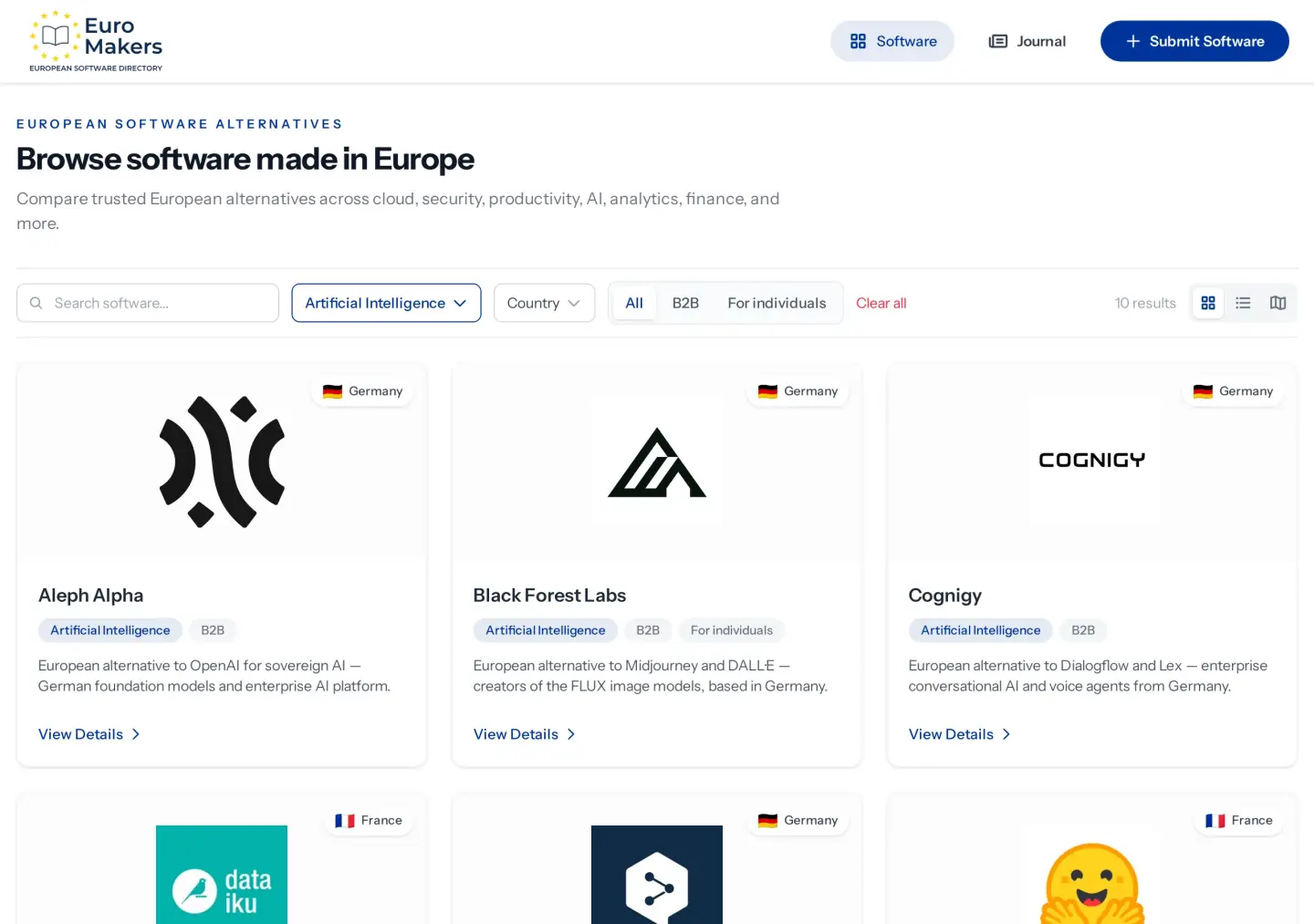
In EuroMakers, that AI seat lives in the Artificial Intelligence category. DeepL is the Cologne language house for translation and writing that keeps nuance. Hugging Face was the Paris open hub for models, datasets, and demos. PhotoRoom is the Paris product-photo craft for catalogue shots without a studio. Aleph Alpha is the Heidelberg private-model house for teams that need to host and explain what they run. Dataiku is the French data-science workshop where analysts and engineers share the same project. Cognigy is the Düsseldorf contact-centre craft for chat and voice that sit in the stack you already have. Black Forest Labs is the German image-generation lab behind the FLUX models. poolside is the Paris coding-model house for software engineering. Melious AI is the Saarbrücken API for open-weight models on European infrastructure. Vibe is Mistral's work-and-code agent for tasks and sandboxed coding. They are siblings in how AI work gets finished — not ten logos fighting over the same prompt box.
Write the Tuesday the model cannot finish
Skip the comparison table for a minute. Write the sentence that describes this Tuesday.
- I need translation and writing that still sounds like us.
- I need an open hub to find, share, and run models without one closed vendor.
- I need product photos that look studio-made, at catalogue speed.
- I need foundation models we can host for regulated work.
- I need a workshop where data people and business people finish the same project.
- I need chat and voice agents that join the contact centre, not a side chatbot.
- I need image generation with models we can actually license.
- I need coding models aimed at software engineering, not a general chat window.
- I need familiar SDKs pointed at open-weight models on EU infrastructure.
- I need one agent that can run work tasks and coding sessions.
- I actually need an IDE, a RAG pipeline, or a design canvas — not another model house.
If the friction is finishing AI work in the right seat, you want Artificial Intelligence. If the friction is the editor, the vector store, or the RAG path, return to the developer tools guide. If the friction is pictures you draw and layout yourself, open the design tools guide. Made in Europe is the quality bar either way: craft, restraint, and makers across the continent — not a rule that one model must own every Tuesday.
Ten European AI crafts
Here is how the current listings differ when you ask which job should live on the table this week — and who the tool is built to serve.
DeepL — language craft
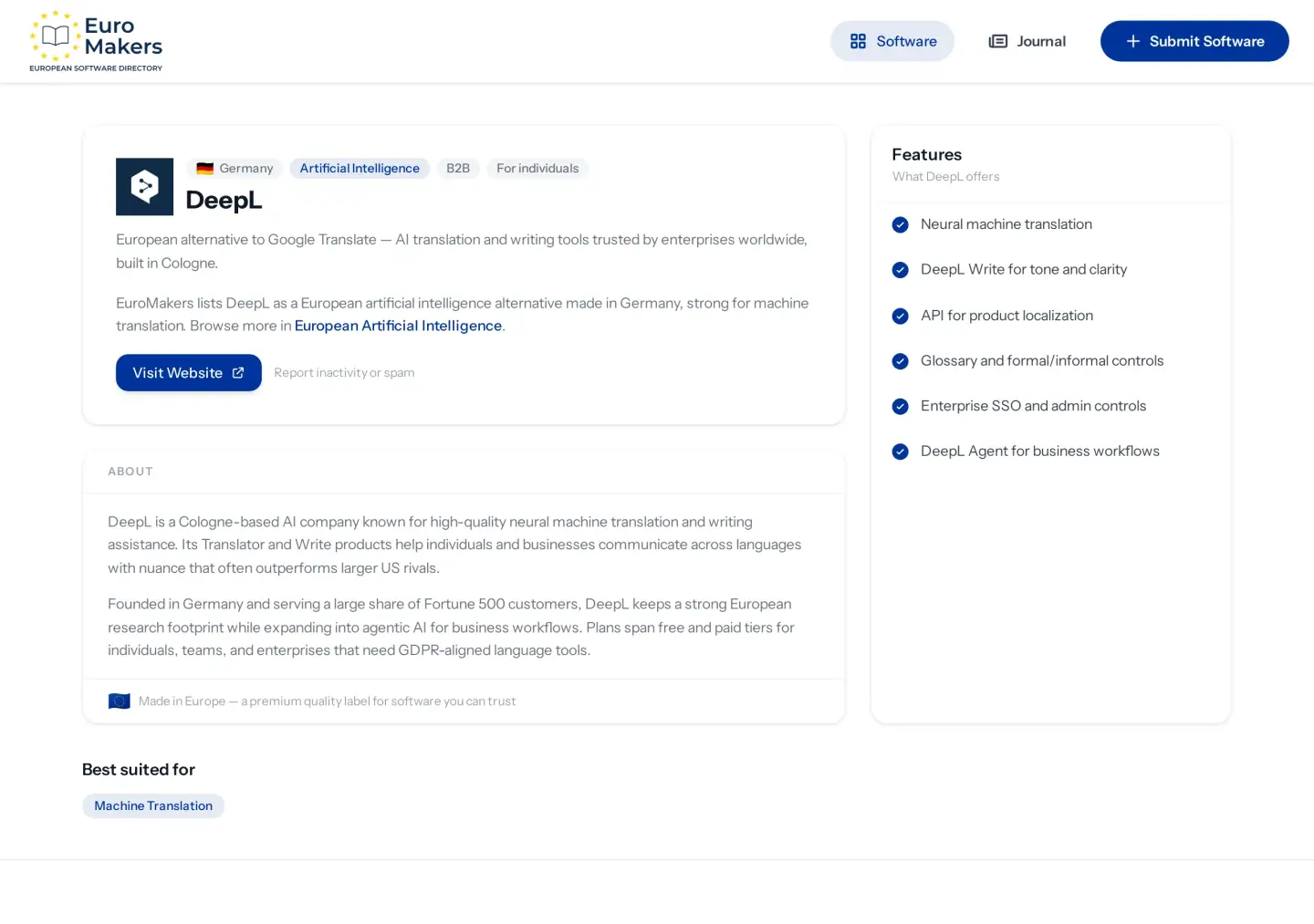
DeepL, from Cologne, is built for the sentence that still has to sound like a person. Neural translation, DeepL Write for tone and clarity, glossaries, formal and informal controls, and an API when the product itself needs localisation. The craft is language that keeps nuance — not a general assistant wearing a dictionary.
Choose DeepL when the job is the letter: a contract, a support reply, a product page in five languages, a paragraph you would still send. It suits people and companies who write across Europe and want a German language house they will still open on Friday. If you need an open hub of models, browse Artificial Intelligence. If you need a contact-centre voice, that is Cognigy — not a louder translator.
Hugging Face — open hub craft
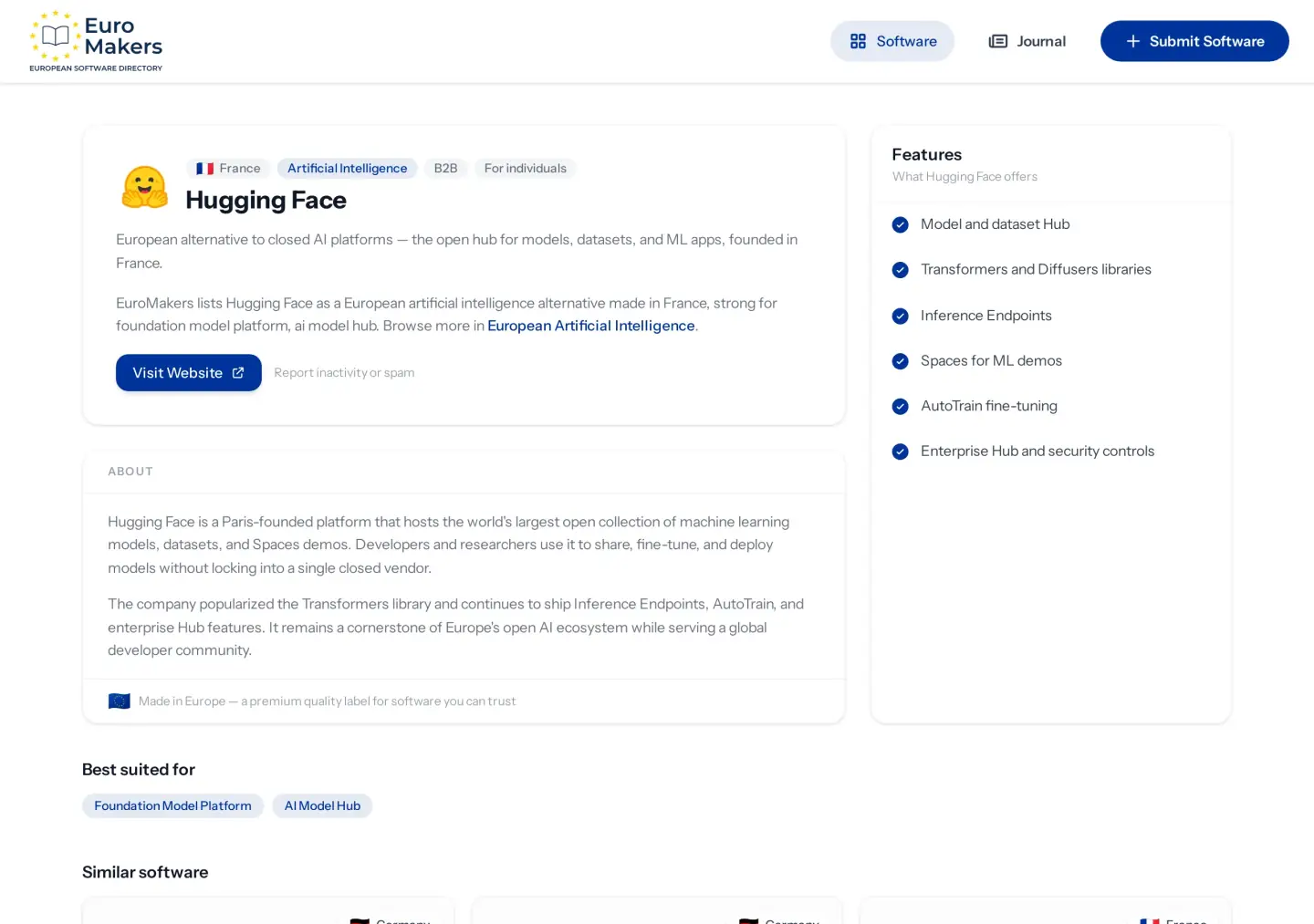
Hugging Face, founded in Paris, is the place Europe (and the rest of the world) puts models, datasets, and Spaces on a table you can actually walk around. Transformers and Diffusers, Inference Endpoints, AutoTrain, and a Hub that stays open instead of locking you to one closed house. The craft is the workshop wall — not a single chat product with extra files. NVIDIA is acquiring Hugging Face, so it no longer qualifies as independent European software and is not in the directory.
The hub job was Hugging Face: find a model, fine-tune it, demo it, share it. It suited researchers, builders, and teams who wanted a French-founded open path rather than renting one vendor's entire brain. If you only need to point an SDK at EU-hosted open-weight models, Melious is the clearer neighbour. If you need private models you host yourself for regulated work, look at Aleph Alpha.
PhotoRoom — product-photo craft
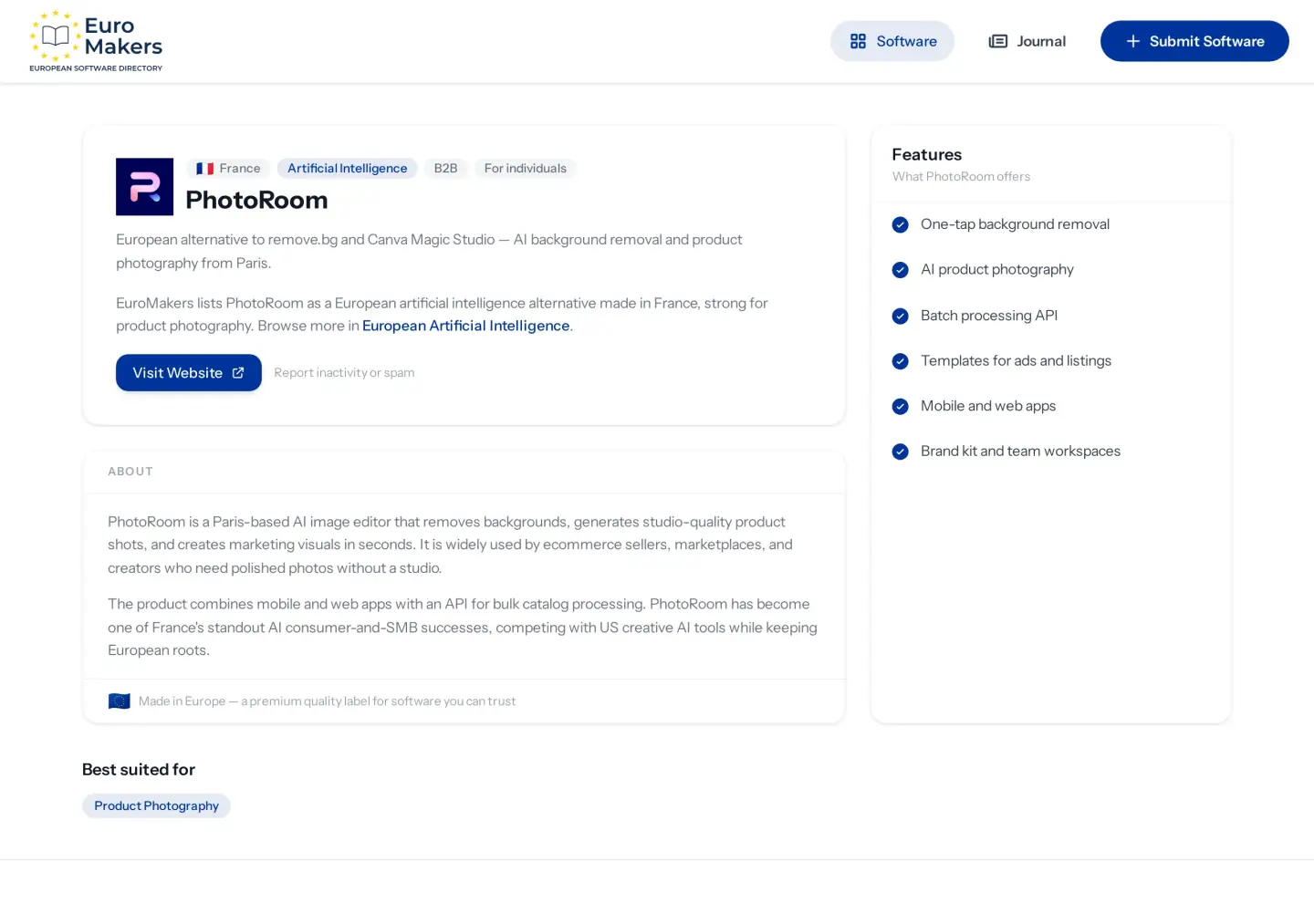
PhotoRoom, from Paris, is built for the catalogue that cannot wait for a studio. Background removal, AI product shots, batch APIs, templates for listings and ads, and apps on phone and web. The craft is finishing the picture the shop needs — not a general image model that happens to crop well.
Choose PhotoRoom when the job is the listing photo: a shoe, a vase, a marketplace pack of SKUs. It suits sellers and marketers who want French product-photo craft at catalogue speed. If you are generating scenes from a prompt, that is Black Forest Labs. If you are retouching on a desktop canvas, return to Affinity or Photopea in the design tools guide — neighbouring crafts, not upgrades.
Aleph Alpha — private-model craft
Aleph Alpha, from Heidelberg, builds foundation models and a platform for teams that need to host, explain, and control what they run. On-prem and private cloud, multimodal models, transparency tooling, and an architecture aimed at public-sector and regulated company work. The craft is a model house you can keep in the building — not an open hub with extra locks.
Choose Aleph Alpha when the job is private models: a government team, a bank, a hospital, a company that cannot send every prompt to a rented endpoint. It suits teams who will actually operate the stack, not teams who wanted a chat window by Friday. If you need an open collection of community models, Hugging Face is no longer in the directory — browse Artificial Intelligence. If you need EU-hosted open-weight inference with familiar SDKs, Melious is the sibling — not a quieter Aleph Alpha.
Dataiku — data-science workshop craft
Dataiku, from France, is the shared workshop where data scientists, analysts, and the people who will use the result can sit at the same table. Visual and code workflows, data preparation, MLOps, model governance, and room for generative projects without pretending the whole company is a research lab. The craft is finishing a data project together — not a foundation-model house with extra charts.
Choose Dataiku when the job is the workshop: a scoring model, a governed notebook, a pipeline the business can still open. It suits larger organisations that need collaboration and control in one place. If you needed a contact-centre agent, that is Cognigy. If you needed vectors and RAG as a developer layer, that is Qdrant and Haystack on the developer tools shelf — neighbours, not a second Dataiku.
Cognigy — contact-centre agent craft
Cognigy, from Düsseldorf, is built for the queue that already exists. Low-code chat and voice agents, multilingual understanding, CRM and telephony integrations, handoff to humans, and the controls a contact centre actually needs. The craft is service that answers — not a work agent that also happens to chat.
Choose Cognigy when the job is the phone and the widget: refunds, bookings, status, the 4 p.m. spike. It suits service teams who need German conversational craft inside the stack they already run. If you wanted a personal work-and-code agent, look at Vibe. If you wanted live chat for a marketing site, Crisp lives in the marketing tools guide — a neighbouring desk, not a quieter Cognigy.
Black Forest Labs — image-generation craft
Black Forest Labs, from Germany, is the lab behind the FLUX family of text-to-image models. Strong prompt adherence, API access, commercial licensing, and research that still shows up in product work. The craft is pictures from language — not product photography for a catalogue, and not a design canvas you layout by hand.
Choose Black Forest Labs when the job is generation: a concept, a campaign still, a product scene that does not exist yet. It suits builders and creative teams who want German image models they can license. If you need to clean and stage SKUs you already photographed, return to PhotoRoom. If you are drawing interfaces or decks, the creative shelf is next door.
poolside — coding-model craft
poolside, from Paris, builds foundation models and products aimed at software engineering. Private deployment options, a European research base, and a focus on the repo rather than a general chat that sometimes writes functions. The craft is coding models for company engineering — not a daily work agent with a terminal tab.
Choose poolside when the job is the engineering model: teams that want coding AI with a French lab behind it, and the option to keep it closer to the code. It suits organisations ready to evaluate a model house, not someone who wanted an assistant in the browser this afternoon. If you need an IDE you already live in, that is JetBrains. If you need a work-and-code agent with modes for mail and sandboxes, Vibe is the sibling.
Melious AI — EU-hosted open-model API craft
Melious AI, from Saarbrücken, runs open-weight models on European infrastructure and exposes them through one OpenAI- and Anthropic-compatible API. Keep the SDK, change the base URL; chat completions, streaming, tool calling, a built-in chat with search and code execution, and managed vectors when you need retrieval. The craft is inference you can point at Europe — not a second Hugging Face Hub, and not a private foundation-model house.
Choose Melious when the job is the endpoint: a prototype, a product feature, a team that wants strong open models without leaving European ground. It suits builders who already know the SDK shape and care where the request lands. If you need to browse and share thousands of community models, Hugging Face is no longer in the directory — browse Artificial Intelligence. If you need models you operate yourself for regulated work, return to Aleph Alpha.
Vibe — work-and-code agent craft
Vibe, from Mistral in France, is a unified agent with Work Mode for multi-step tasks and Code Mode for sandboxed coding. Connectors for mail, chat, and GitHub, voice input, a VS Code extension and CLI, and memory across conversations. The craft is an assistant that can run a week of work and code — not a contact-centre platform, and not a foundation-model lab sold as a chat window.
Choose Vibe when the job is the agent: triage, drafts, a coding session you can leave running, a French lab product you will actually open. It suits people and teams who want one work-and-code surface rather than ten specialist models. If you need contact-centre voice, return to Cognigy. If you need coding models as a house for engineering, look at poolside. If the real pain is the IDE, stay with JetBrains.
A short shortlist, not a winner
There is no single European AI winner across these ten crafts. Match the Tuesday you keep missing:
- You need translation and writing that keep tone → start with DeepL.
- You need an open hub for models, datasets, and demos → browse Artificial Intelligence.
- You need catalogue photography without a studio → try PhotoRoom.
- You need private foundation models you can host → look at Aleph Alpha.
- You need a shared data-science workshop → try Dataiku.
- You need chat and voice in the contact centre → try Cognigy.
- You need licensed image generation from prompts → try Black Forest Labs.
- You need coding models for software engineering → look at poolside.
- You need open-weight models on EU infrastructure with familiar SDKs → try Melious AI.
- You need a work-and-code agent → try Vibe.
- You actually need an IDE, RAG pipelines, or a design canvas → stop — open the developer tools guide or the design tools guide; those are different shelves.
Germany specialises in language, private models, contact-centre agents, image generation, and EU-hosted inference. France specialises in the open hub, product photography, the data-science workshop, coding models, and the work-and-code agent. That spread is the point of a healthy European market — not ten logos fighting over the same prompt box.
How to trial without replacing your whole week
AI swaps fail when people cancel every subscription on Monday and spend the week hunting for what used to be easy. Keep the first week reversible.
- Pick one AI craft: language, open hub, product photos, private models, data workshop, contact-centre agents, image generation, coding models, EU-hosted API, or work-and-code agent.
- Move a small live job — one language pair, one SKU batch, one support intent, one repo, or one prompt workflow — not every Tuesday at once.
- Run only that job for seven ordinary days: tired, on a deadline, the way your week actually works.
- Test the boring moments: a glossary miss, a background that will not go, a handoff the agent refuses, a licence you cannot keep, an endpoint that leaves Europe.
- Only then widen projects, invite the team, and retire the old tool for that job.
Where Made in Europe feels premium
Made in Europe matters in AI when it shows up as craft: language that still sounds like you, pictures a catalogue can publish, models you can host or point at European ground, and agents that finish a real queue. It is a premium quality label when the tool feels built for people who work carefully — not as a growth funnel wearing a model badge.
There is also a quiet unity story here. A Cologne language house, a Paris hub and photo studio, a Heidelberg model lab, a Düsseldorf contact centre, a Black Forest image lab, and a Saarbrücken API can sit in the same European week without pretending to be the same product. European software is often strongest when countries specialise — and when you keep sibling AI seats clear instead of stacking ten apps that fight for the same Tuesday.
Choose the AI tool that matches the job on the table, not the one that promises to be every job.
— EuroMakers Journal
Start here
Open the Artificial Intelligence category, read DeepL, PhotoRoom, Aleph Alpha, Dataiku, Cognigy, Black Forest Labs, poolside, Melious AI, and Vibe, and run one careful week with a small live job. If the editor, the RAG path, or the canvas is the real job, browse Developer Tools, Design, and their guides. Building a wider European stack? Browse the directory or keep reading the Journal. Missing a European AI tool we should know about? Tell us.
Montags-Digest
Europas beste neue Software, jeden Montag.
Top-Launches, neue Einträge und Geschichten aus dem Journal. Eine E-Mail, in ruhigen Wochen keine.
Find your next European tool
Every product in the directory is checked before it goes live and shows where it’s made. Start with a tool you use today.
Explore the directory
