How to Choose European Design Tools for the Creative Job You Actually Have
A practical guide to European design software — Affinity, Penpot, Framer, Miro, and Pitch — based on the creative craft you need: desktop suites, open interface design, live sites, workshops, or team decks.
The EuroMakers Editorial Team
Researching European software

The Journal · Made in Europe
Design shopping rarely starts with a feature sheet. It starts with a Thursday that feels stuck. A brand pack lives in three folders. The website mock never becomes the website. A workshop board dies after the call. Slides still look like a template someone rescued from 2019. The pain is not "we need more creative software." The pain is "we cannot finish the work in the tool that matches how we make."
In EuroMakers, that creative seat lives in the Design & Creative category. Affinity is the UK desktop house for photo, layout, and vector work. Penpot is the Spanish open design and prototyping platform you can self-host. Framer is the Dutch canvas that ships production websites. Miro is the Amsterdam whiteboard for workshops that need a shared surface. Pitch is the Berlin presentation craft for teams that build decks together. They are siblings in how you create — not five logos fighting over the same blank page.
Write the Thursday your tools keep missing
Skip the comparison table for a minute. Write the sentence that describes this month.
- We need desktop apps that handle photo, layout, and vectors without a subscription maze.
- We need interface design and prototypes we can collaborate on — and host ourselves if we want.
- We need a marketing site that ships from the same canvas we design in.
- We need a shared board for workshops that survives after the call ends.
- We need collaborative slides with brand kits, comments, and honest deck analytics.
- We actually need a quick browser photo edit — or a full 3D world — not another interface twin.
If the friction is finishing creative work in the right surface, you want Design & Creative. If the friction is project rooms, notes, or sales follow-ups, return to Stackfield, Capacities, and the CRM guide — different seats. Made in Europe is the quality bar either way: craft, restraint, and makers across the continent — not a rule that one product must own every pixel.
Five European creative crafts
Here is how the current listings differ when you ask how making should feel day to day — and who the tool is built to serve.
Affinity — desktop creative craft
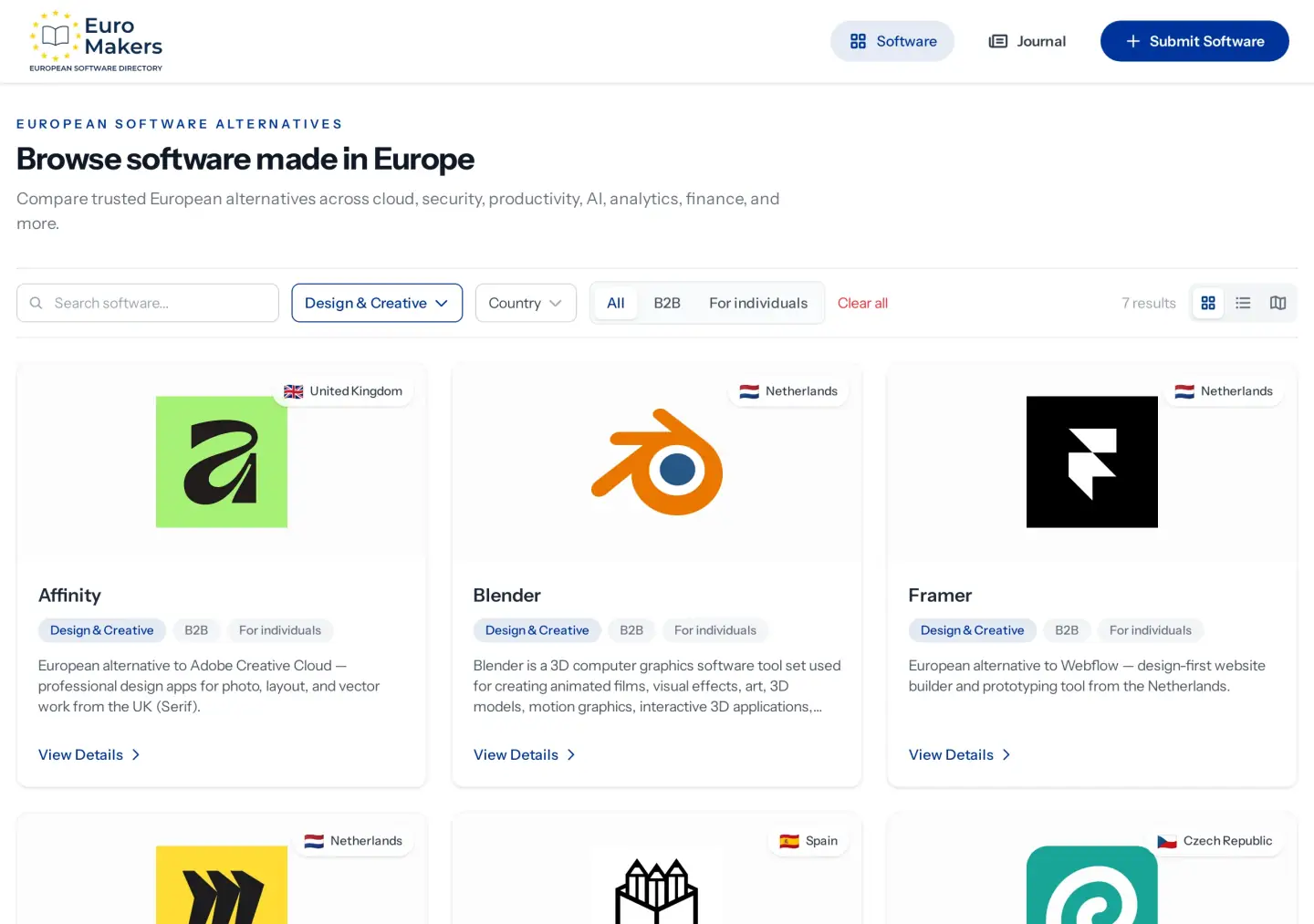
Affinity, from the UK (Serif), is built for professionals who want photo editing, vector graphics, and page layout with desktop performance and serious format support. It is the catalog's clearest European answer when the job is print-ready layouts, detailed pixel work, and vector craft — without treating a creative suite as an endless cloud subscription.
Choose Affinity when the job is a desktop creative house: PSD-friendly photo work, publishing layouts, and vector design on machines you control. It suits freelancers, studios, and marketers who live in files, not only in browser canvases. If your pain is collaborative interface systems you can self-host, or a site that publishes from the design canvas, look at Penpot and Framer below.
Penpot — open interface craft
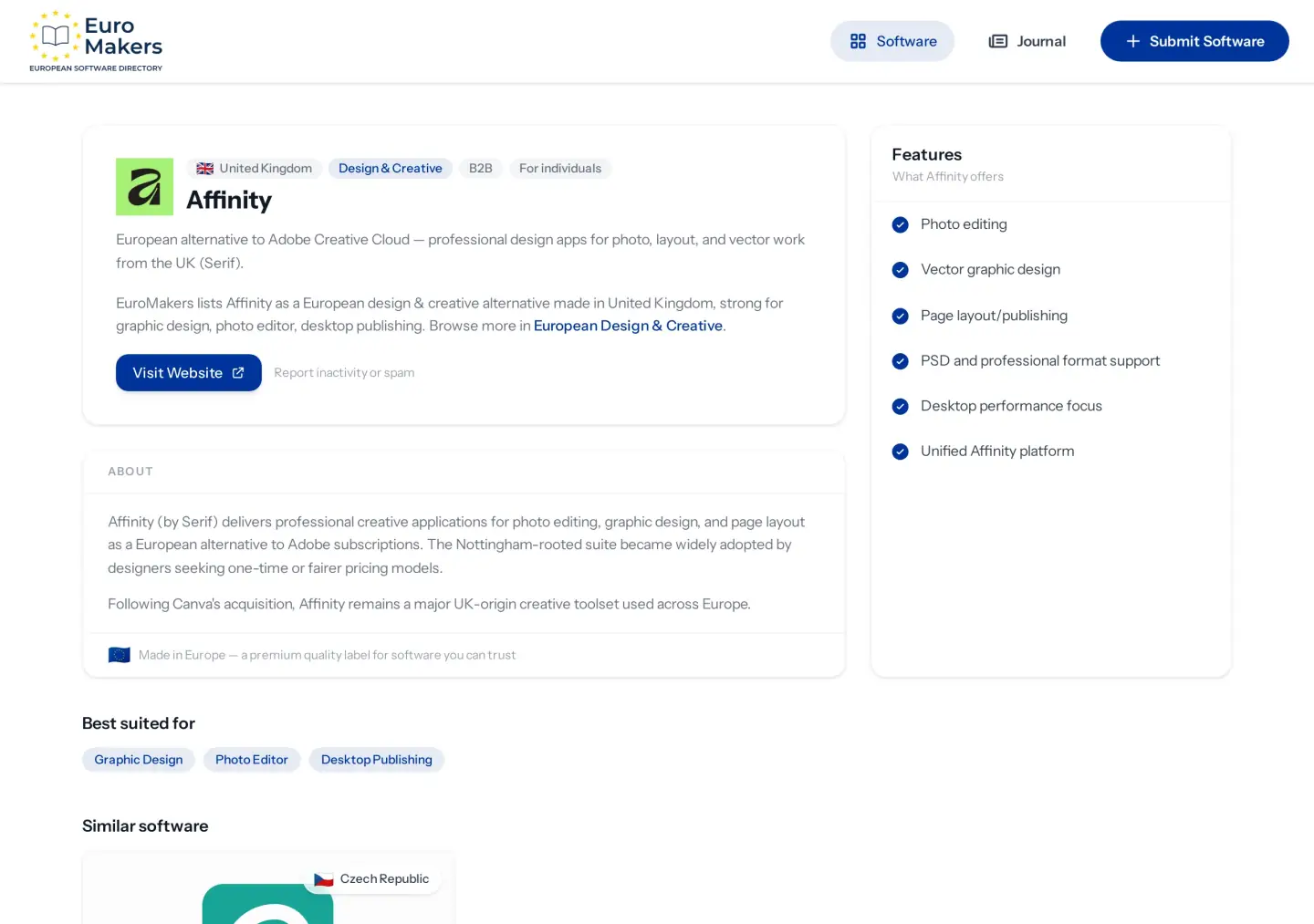
Penpot, from Spain, is built for interface design and prototyping with real-time collaboration, design systems, and a self-hosting option. SVG-friendly and web-standards minded, it aims at teams that want collaborative UI workflows without locking the studio into a single vendor house they cannot move.
Choose Penpot when the job is an open interface studio: components, prototypes, and collaboration — with the option to host the stack yourself. It suits product teams and agencies that care about ownership as much as polish. If you need a site that goes live from the canvas, Framer is the sibling. If you need desktop print and photo depth, Affinity stays the better house.
Framer — site craft from the canvas
Framer, from the Netherlands, is built so designers can take a canvas to a production website. CMS and localization, advanced animations, included hosting and publishing, and team collaboration sit under one roof — closer to shipping marketing sites than to prototypes that never leave the file.
Choose Framer when the job is a live site that still feels designed: animations that ship, content that updates, and a publish path that does not hand the file to another team. It suits studios and growth teams who bounce off page builders that feel like spreadsheets with themes. If the real pain is interface systems for a product, Penpot may fit better. If the pain is a workshop board, Miro is the neighbour.
Miro — workshop craft on a shared board
Miro, from Amsterdam, is built for infinite online whiteboards, workshop and agile templates, real-time multiplayer editing, and integrations with the productivity tools teams already open. AI facilitation features sit on top of a surface meant for rooms of people thinking together — not for finishing a print file alone.
Choose Miro when the job is a workshop that needs a board: sticky sessions, journey maps, agile rituals, and a canvas people reopen after the call. It suits facilitators, product teams, and consultants who lose momentum when ideas stay in chat. If you need collaborative slides with brand kits, Pitch is the sibling. If you need project rooms with tasks and files, that is Stackfield — a different seat.
Pitch — deck craft for modern teams
Pitch, from Berlin, is built for collaborative presentations: real-time editing, modern templates and brand kits, slide analytics, work-tool integrations, and version history with comments. It aims at teams that present every week and want decks that feel current — not slides rescued from a shared drive.
Choose Pitch when the job is a deck house: brand-consistent slides, comments that resolve, and analytics that show which slides held attention. It suits startups, agencies, and internal teams who live in presentations. If the pain is a shared workshop board, Miro fits better. If the pain is a marketing site, return to Framer.
A shortlist by how you make
- You want desktop photo, layout, and vector craft without a subscription maze → start with Affinity.
- You want collaborative interface design you can self-host → try Penpot.
- You want a marketing site that ships from the design canvas → try Framer.
- You want workshop boards people reopen after the call → try Miro.
- You want collaborative decks with brand kits and slide analytics → try Pitch.
- You need a quick browser photo edit — or a full 3D world — not another interface twin → stop — that is Photopea or Blender, neighbouring crafts on the same shelf.
The UK specialises in desktop creative depth. Spain specialises in open interface studios. The Netherlands specialises in site canvases and workshop boards. Germany specialises in collaborative decks. The Czech Republic and the Netherlands again add browser photo craft and world-class 3D. That spread is the point of a healthy European market — not five logos fighting over the same blank artboard.
How to trial without stranding your files
Creative swaps fail when teams announce a big migration and abandon the old suite on day two. Keep the first fortnight reversible.
- Pick one creative craft: desktop suite, open interface studio, site canvas, workshop board, or deck house.
- Move a small live set — one campaign, one prototype, one workshop, or one deck series — not the entire brand archive.
- Run only that set for ten working days: open files, collaborate, export, publish, and reopen on the devices you actually use.
- Test the boring moments: a shared component, a CMS update, a guest editor, an export that must land in print, a slide someone comments on late.
- Only then widen the team, set naming rules, and retire the old tool for that job.
Where Made in Europe feels premium
Made in Europe matters in design tools when it shows up as craft: products shaped around how people actually make, interfaces that respect a busy Thursday, and companies that treat creative files as something worth keeping carefully — not as a growth funnel wearing a canvas badge. It is a premium quality label when the tool feels built for teams who finish work honestly.
There is also a quiet unity story here. A UK desktop suite, a Spanish open studio, Dutch site and workshop crafts, and a Berlin deck house can sit in the same European week without pretending to be the same product. European software is often strongest when countries specialise — and when you keep sibling seats clear instead of stacking five canvases that fight for the same blank page.
Choose the design tool that matches how you make, not the one with the loudest template gallery.
— EuroMakers Journal
Start here
Open the Design & Creative category, read Affinity, Penpot, Framer, Miro, and Pitch, and run one careful fortnight with a small live set. If browser photo edits or 3D worlds are the real job, compare Photopea and Blender as neighbouring crafts. Building a wider European stack? Browse the directory or keep reading the Journal. Missing a European design tool we should know about? Tell us.
Find your next European tool
Browse a curated directory of software made in Europe across every category your team relies on.
Explore the directory
