How to Choose a European CRM for the Sales Job You Actually Run
A practical guide to European CRM — Pipedrive, noCRM, folk, and Salesflare — based on the sales craft you need: visual pipelines, a lean lead desk, relationship-led work, or a CRM that fills itself.
The EuroMakers Editorial Team
Researching European software

The Journal · Made in Europe
CRM shopping rarely starts with a feature matrix. It starts with a Tuesday that feels thin. Deals live in someone's head. Follow-ups hide in inboxes. A shared spreadsheet pretends to be a pipeline until two people update different columns. The pain is not "we need more software." The pain is "we cannot see the next honest move."
In EuroMakers, that sales seat lives in the CRM category. Pipedrive is the Estonian pipeline house — visual stages, activity-based selling, and a marketplace when the team grows. noCRM.io is the French lead desk built for daily execution without heavy platform weight. folk is the French relationship CRM for teams that sell through networks, not only stages. Salesflare is the Belgian CRM that autofills customer timelines so empty fields stop being the job. They are siblings in how you sell — not four logos fighting over the same sales sentence.
Write the Tuesday your pipeline keeps missing
Skip the comparison table for a minute. Write the sentence that describes this month.
- We need a visual pipeline the whole team can trust by Friday.
- We need a simple lead desk people will open before they invent another sheet.
- We sell through relationships and networks, not only stage gates.
- We hate empty CRM fields more than we hate imperfect forecasts.
- We actually need CRM under the same roof as quotes, projects, and invoices.
If the friction is "deals and follow-ups keep vanishing," you want CRM. If the friction is shared project rooms, notes, or signing paperwork, return to Stackfield, Capacities, Tally, and Documenso — different seats on the desk. Made in Europe is the quality bar either way: craft, restraint, and makers across the continent — not a rule that one product must own every client touch.
Four European sales crafts
Here is how the current listings differ when you ask how selling should feel day to day — and who the CRM is built to serve.
Pipedrive — visual pipeline craft
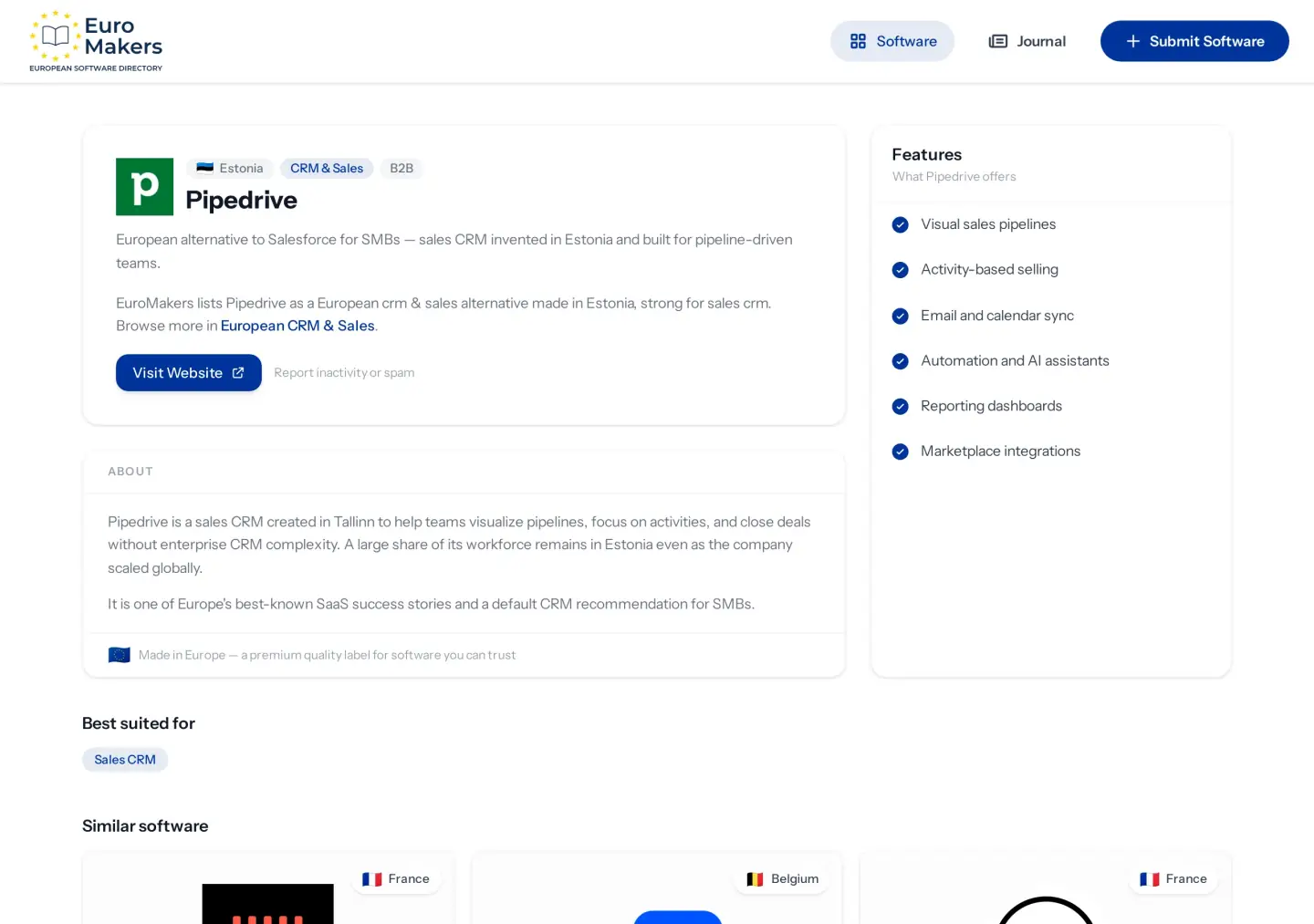
Pipedrive, invented in Estonia, is built for teams that want to see deals move. Visual pipelines, activity-based selling, email and calendar sync, automation and AI assistants, reporting dashboards, and a marketplace of integrations cover SMBs that outgrew a shared sheet but do not want a heavy admin house. A large share of its workforce remains in Estonia even as the product scaled globally — one of Europe's clearest SaaS success stories in sales software.
Choose Pipedrive when the job is pipeline clarity: stages the team can scan, activities that keep deals honest, and room to grow without pretending you need a heavy admin suite on day one. It suits B2B teams that live in deal stages. If your pain is a lean lead desk, a relationship-first network CRM, or a system that autofills itself, look at the siblings below.
noCRM.io — the lean lead desk
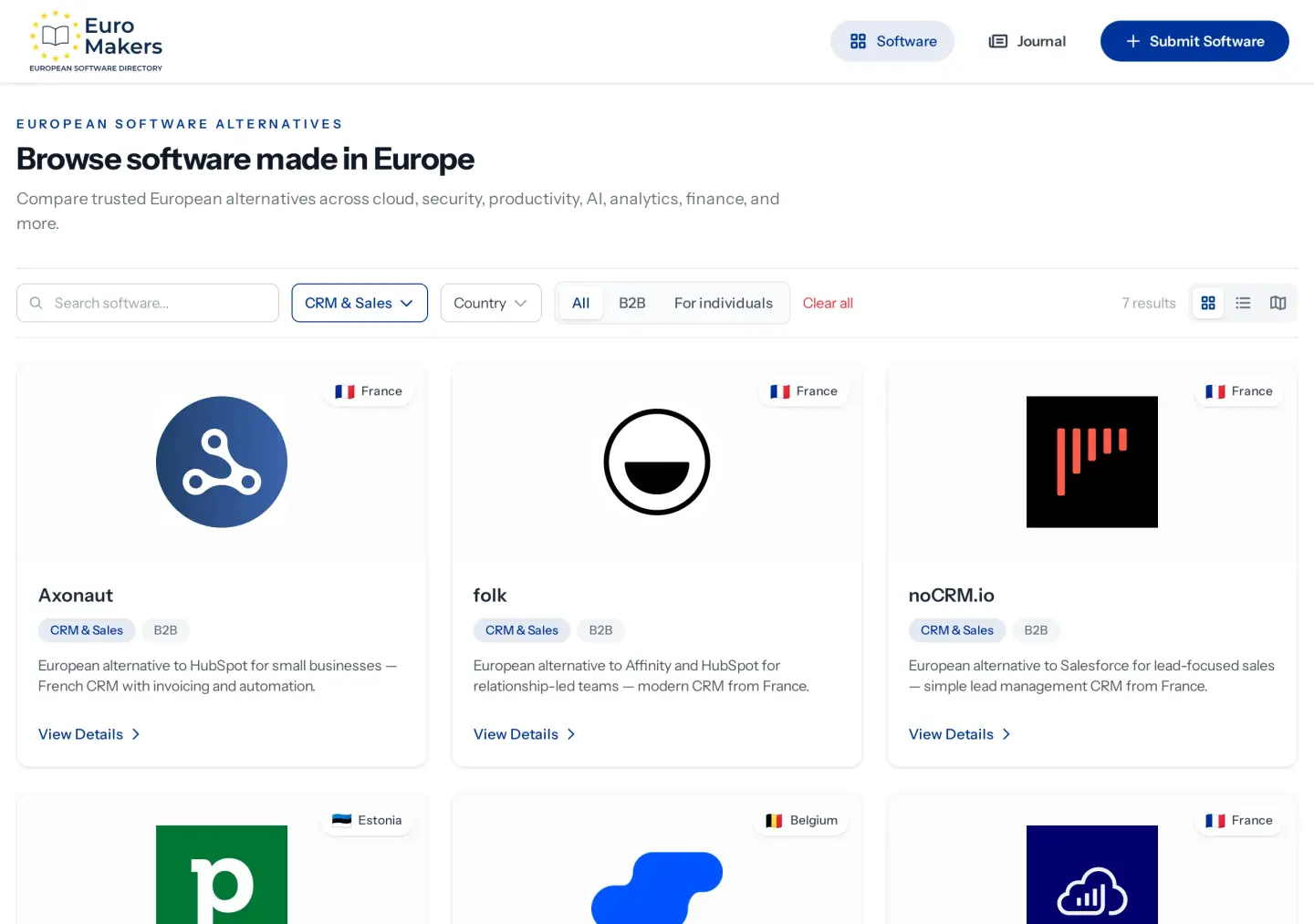
noCRM.io, from France, is built for sales teams that want lead-centric pipelines without the overhead of a heavy platform CRM. Sales scripts and checklists, email and calling integrations, goal tracking, simple reporting, and fast team onboarding keep the focus on daily execution — first touch to close — rather than months of configuration.
Choose noCRM when the job is a lead desk people will actually open: fewer empty fields, clearer next steps, and adoption over long configuration. It suits SMBs that bounce off heavy platforms. If you need visual deal stages with a wide marketplace, start with Pipedrive. If relationships and networks are the spine, look at folk.
folk — relationship-led selling
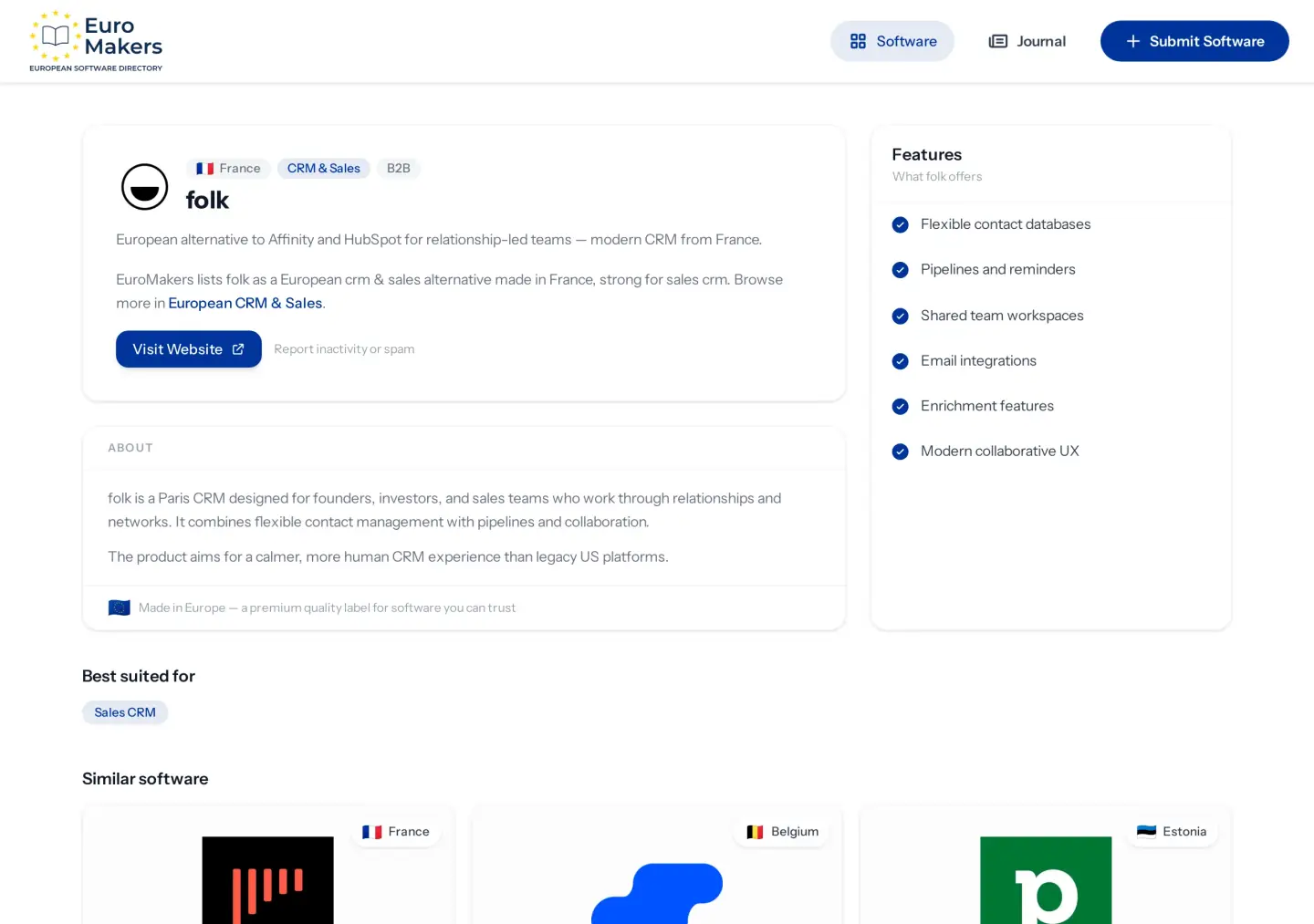
folk, from France, is built for founders, investors, and sales teams who work through relationships and networks. Flexible contact databases, pipelines and reminders, shared team workspaces, email integrations, enrichment features, and a modern collaborative feel aim for a calmer human CRM — closer to how relationship-led teams already think than to a rigid stage machine.
Choose folk when the job is a relationship house: contacts as the centre of gravity, networks that need shared memory, and pipelines that support people rather than replace them. It suits teams leaving relationship CRMs that feel too rigid, or HubSpot setups that feel colder than the way they sell. If empty fields are the daily enemy, Salesflare may fit better.
Salesflare — the CRM that fills itself
Salesflare, from Belgium, is built to reduce manual data entry by gathering customer information from email, calendar, and the web. Automatic enrichment, an email and calendar timeline, pipeline management, email tracking, mobile apps, and simple automation suit startups and sales teams that dislike empty CRM fields more than they dislike imperfect dashboards.
Choose Salesflare when the job is a quieter shelf that stays current: less typing, more timeline, and a CRM that earns trust by showing what already happened. It suits teams who abandoned tools because nobody kept the records honest. If you need a full SME workbench with invoicing under the same roof, look at the neighbours below — not a fourth clone of the same sales craft.
A shortlist by how you sell
- You want visual pipelines, activity-based selling, and room to grow → start with Pipedrive.
- You want a lean lead desk the team will open without a long setup → try noCRM.io.
- You sell through relationships, networks, and shared contact memory → try folk.
- You hate empty fields and want automatic timelines → try Salesflare.
- You actually need CRM plus quotes, projects, and invoices in one house → stop — that is Teamleader, Sellsy, or Axonaut, not a pure sales CRM stretched thin.
Estonia specialises in pipeline clarity that scaled. France specialises in lean lead desks and relationship houses. Belgium specialises in quieter autofill and SME workbenches nearby. That spread is the point of a healthy European market — not four logos fighting over the same sentence.
How to trial without stranding your deals
CRM swaps fail when teams announce a big migration and abandon the old sheet on day two. Keep the first fortnight reversible.
- Pick one sales craft: visual pipeline, lean lead desk, relationship house, or autofill shelf.
- Import a small live set — one team, one pipeline, or one relationship circle — not the entire history.
- Run only that set for ten working days: create deals, log activities, send follow-ups, and reopen on mobile.
- Test the boring moments: a stale deal, a shared reminder, an enrichment miss, a report your manager actually asks for.
- Only then widen the team, set hygiene rules, and retire the old sheet for that job.
Where Made in Europe feels premium
Made in Europe matters in CRM when it shows up as craft: products shaped around how people actually sell, interfaces that respect a busy Tuesday, and companies that treat customer memory as something worth keeping carefully — not as a growth funnel wearing a sales badge. It is a premium quality label when the tool feels built for teams who close work honestly.
There is also a quiet unity story here. An Estonian pipeline house, French lead and relationship crafts, and Belgian autofill can sit in the same European week without pretending to be the same product. European software is often strongest when countries specialise — and when you keep sibling seats clear instead of stacking four CRMs that fight for the same follow-up.
Choose the CRM that matches how you sell, not the one with the loudest feature list.
— EuroMakers Journal
Start here
Open the CRM category, read Pipedrive, noCRM, folk, and Salesflare, and run one careful fortnight with a small live set. If quotes and invoices belong under the same roof, compare Teamleader, Sellsy, and Axonaut as workbench neighbours. Building a wider European stack? Browse the directory or keep reading the Journal. Missing a European CRM we should know about? Tell us.
Find your next European tool
Browse a curated directory of software made in Europe across every category your team relies on.
Explore the directory
