How to Choose European Team Chat Your Company Will Keep Opening
A practical guide to European team chat — Element and Wire — based on the room craft you need: Matrix rooms you can host and federate, or a Swiss encrypted collaboration house with guest rooms.
The EuroMakers Editorial Team
Researching European software

The Journal · Made in Europe
Team chat shopping rarely starts with architecture. It starts with a noisy Monday. Threads that scatter across email. Decisions trapped in a side channel nobody can search. A guest who needs one clean room for a fortnight — and somehow ends up with four apps and a password reset.
In EuroMakers, that seat lives in the Communication category. Element is the United Kingdom client built on the open Matrix protocol — federation, optional self-hosting, Spaces, and bridges. Wire is the Swiss encrypted collaboration suite with guest rooms for partners and deployment options when the house needs clearer walls. They are siblings in the team-room job — not pocket messengers stretched thin, and not live meetings asked to carry all-day chat.
Write the hallway your team keeps walking
Skip the feature matrix for a minute. Write the sentence that describes this month.
- We need shared work talk in channels and Spaces — with the option to host our own homeserver.
- We want an open protocol that can federate and bridge without locking every ping in one rented house.
- We need end-to-end encrypted business chat with guest rooms for external partners.
- We keep shopping for a personal messenger when the real pain is shared company rooms.
If the friction is "our work talk has no durable house," you want team chat. If the friction is family groups or a phone-number leash, return to Threema and Olvid — different seats on the conversation shelf. Made in Europe is the quality bar either way: craft, restraint, and makers across the continent — not a rule that one product must own every channel.
Two European rooms, two crafts
Here is how the current listings differ when you ask how the room is built — and who holds the keys.
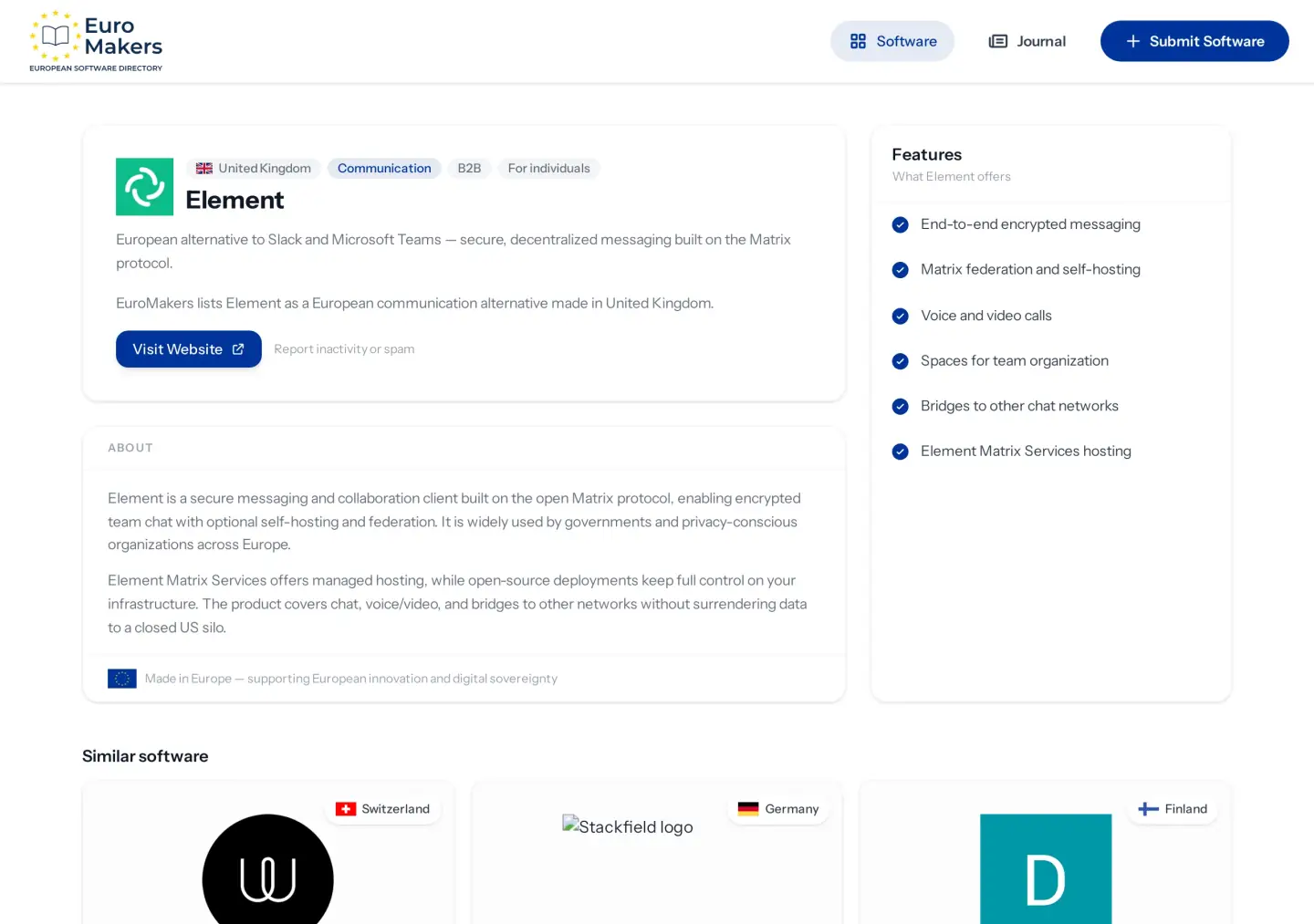
Element — Matrix rooms you can host
Element, from the United Kingdom, is the European alternative to closed team suites that keep every conversation in one rented silo. It sits on the open Matrix protocol: end-to-end encrypted messaging, federation between servers, optional self-hosting, voice and video, Spaces for organisation, and bridges to other networks. Element Matrix Services offers managed hosting when you want the protocol without running the ops yourself.
Choose Element when the job is an open collaboration house: rooms you can explain, a path to host, and federation when partners live on neighbouring servers. It suits teams and individuals who want Matrix craft with a clear European client — not a personal messenger stretched into a company hallway. If your pain is a Swiss encrypted suite with guest rooms and company deployment as the centre of gravity, look at Wire instead.
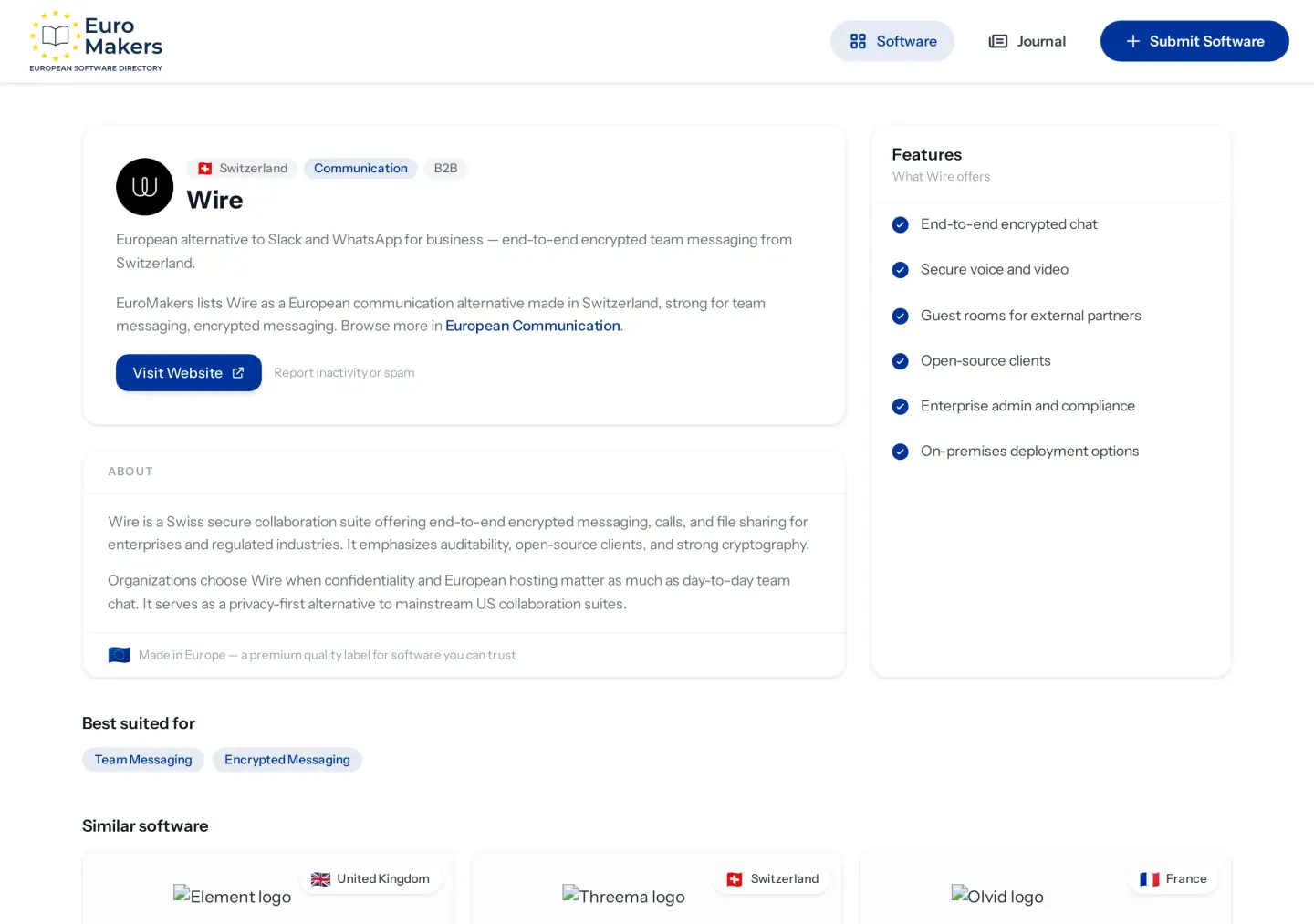
Wire — Swiss encrypted collaboration house
Wire, from Switzerland, is built for teams that need encrypted messaging, calls, and file sharing in one collaboration house. End-to-end encryption is the default posture. Guest rooms let external partners join without turning every conversation into a permanent account. Open-source clients, company controls, and on-premises deployment options cover organisations that want clearer walls around work talk.
Choose Wire when the job is a Swiss-hosted encrypted suite with guest doors and company controls you can explain on Monday morning. It suits companies that want business chat and partner rooms without stretching a consumer pocket messenger into a workplace. If you mainly want Matrix federation, self-hosting, and Spaces as the open spine, start with Element.
A shortlist by how the room should work
- You want Matrix federation, Spaces, and optional self-hosting → start with Element.
- You want managed Matrix without running the homeserver yourself → look at Element Matrix Services after a protocol trial.
- You want a Swiss encrypted collaboration suite with guest rooms → try Wire.
- You actually need a personal pocket or a meeting link → stop — that is Threema, Olvid, Jitsi Meet, or Whereby, not team chat stretched thin.
The United Kingdom specialises in an open Matrix client with federation and hosting choice. Switzerland specialises in an encrypted collaboration house with guest rooms and company walls. That spread is the point of a healthy European market — not two logos fighting over the same hallway.
How to trial without stranding the company
Team chat swaps fail when people announce a big cutover and abandon the old suite on day two. Keep the first fortnight reversible.
- Pick one room craft: Matrix house with hosting choice, or Swiss encrypted suite with guest rooms.
- Stand up desktop and mobile for a small pilot group before you invite the whole company.
- Move one real work stream first — a project Space, a partner guest room, or a leadership channel — and use only that house for ten days.
- Test the boring moments: file share, search, a guest invite, a call, offline reopen, and a settings change.
- Only then widen the circle, set retention habits, and retire the old hallway for that job.
Where Made in Europe feels premium
Made in Europe matters in team chat when it shows up as craft: an open protocol you can host, encryption that is default, guest doors that do not leak the whole house, and products that treat work talk as something worth protecting — not as another badge race. It is a premium quality label when the room feels built for people who collaborate carefully, not loudly.
There is also a quiet unity story here. A Matrix client from the United Kingdom and a Swiss encrypted suite can sit in the same European market without pretending to be the same product. European software is often strongest when countries specialise — and when you keep sibling seats clear instead of stacking four apps that fight for the same ping.
Choose the team room that matches how work talk should live, not the one with the loudest channel list.
— EuroMakers Journal
Start here
Open the Communication category, read Element and Wire, and run one careful fortnight with a small pilot group. If pocket messengers or meeting links are next instead, keep the shelf clear with our messengers guide and conversation shelf essay. Building a wider European stack? Browse the directory or keep reading the Journal. Missing a European team chat tool we should know about? Tell us.
Find your next European tool
Browse a curated directory of software made in Europe across every category your team relies on.
Explore the directory
