How to Choose European Video Meetings Guests Will Actually Join
A practical guide to European live meetings — Jitsi Meet and Whereby — based on the room craft you need: open rooms you can host yourself, or a polished Norwegian browser room with a calm guest door.
The EuroMakers Editorial Team
Researching European software

The Journal · Made in Europe
Meeting shopping rarely starts with codecs. It starts with a guest who never arrives. Another app install before hello. Another account form before the first face. Another call that should have been a five-minute link — and somehow becomes a fifteen-minute scramble.
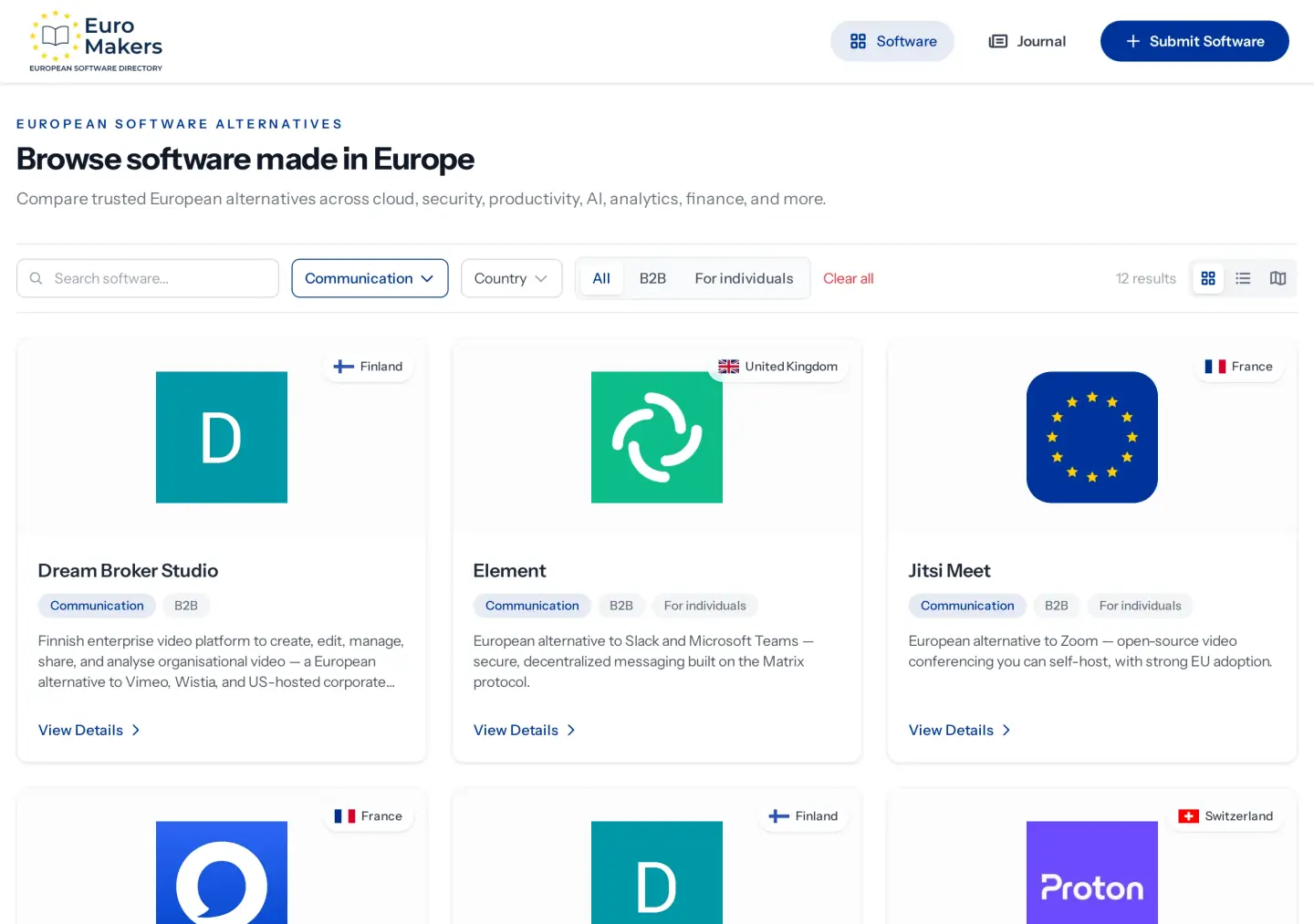
In EuroMakers, that face-to-face seat lives in the Communication category. Jitsi Meet is the French open-source meeting stack you can self-host — browser-based, no account required for basic use, and widely adopted across Europe. Whereby is the Norwegian browser room: share a simple link, skip the install, and brand the door when clients deserve a calmer welcome. They are siblings in the live-meeting job — not team chat asked to carry every face, and not pocket messengers stretched into conference rooms.
Write the Tuesday your guests keep missing
Skip the feature matrix for a minute. Write the sentence that describes this month.
- We need browser meetings that guests can join without creating an account.
- We want to host our own meeting stack for education, public work, or quieter control.
- We need polished personal or team rooms with branding for client and customer calls.
- We keep stretching a chat app's occasional call into our only conference home.
If the friction is "faces and screens keep bouncing at the door," you want live meetings. If the friction is all-day channels or encrypted pocket talk, return to Element, Wire, Threema, and Olvid — different seats on the conversation shelf. Made in Europe is the quality bar either way: craft, restraint, and makers across the continent — not a rule that one product must own every call.
Two European rooms, two crafts
Here is how the current listings differ when you ask how the meeting door is built — and who holds the keys.
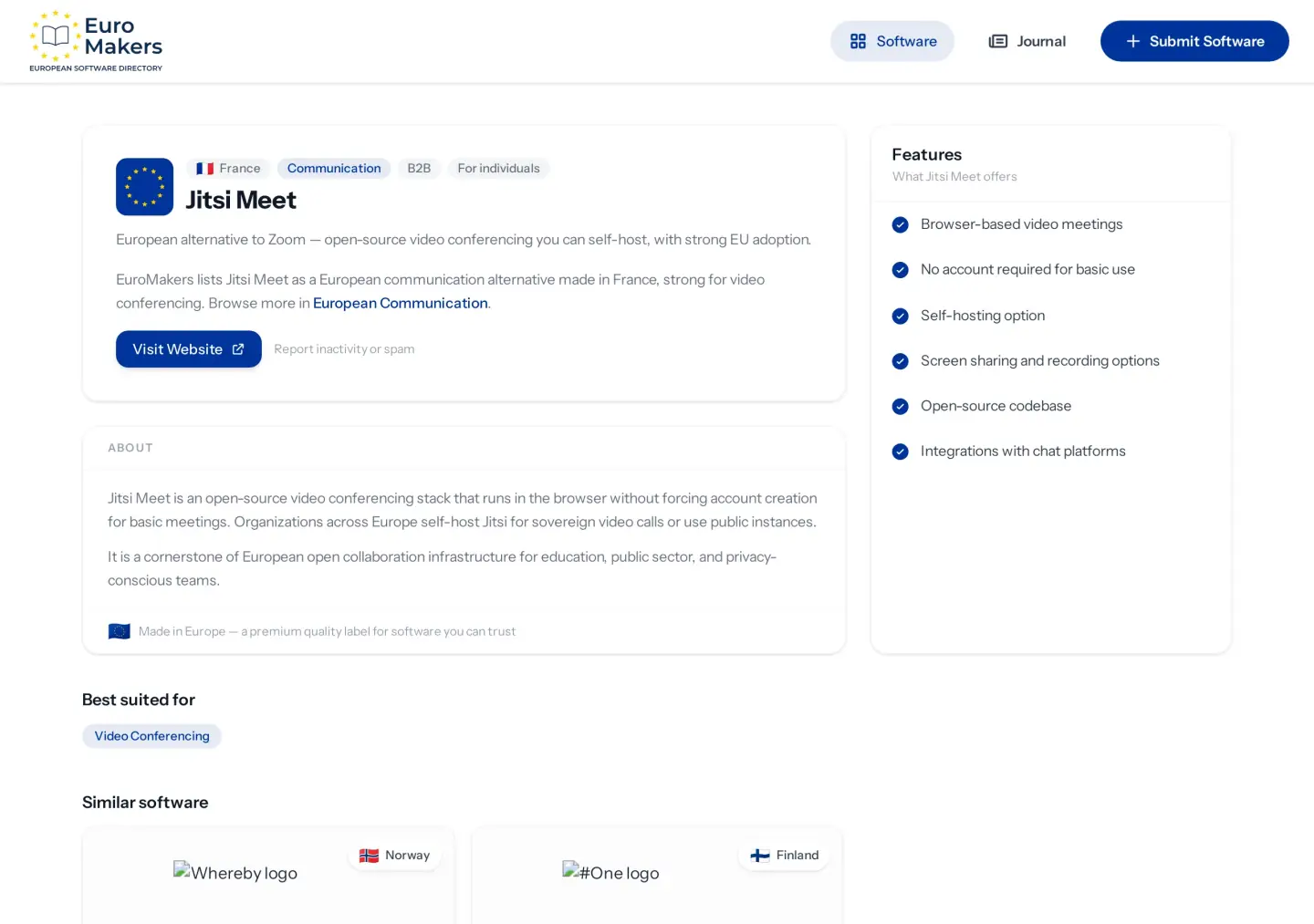
Jitsi Meet — open rooms you can host
Jitsi Meet, from France, is built for teams that want open meeting craft instead of every call living in one rented house. It is an open-source video conferencing stack that runs in the browser. Basic meetings do not force account creation. Organisations across Europe self-host Jitsi when they want the stack under their own roof, or use public instances when a fast shared room is enough. Screen sharing, recording options, and chat integrations sit on top of that open spine.
Choose Jitsi when the job is an open meeting house: a link guests can open, a path to host yourself, and a stack education and public teams already recognise. It suits communities and companies that want European open collaboration craft — not a branded client room as the centre of gravity. If your pain is a polished Norwegian browser door with personal rooms and branding for customers, look at Whereby instead.
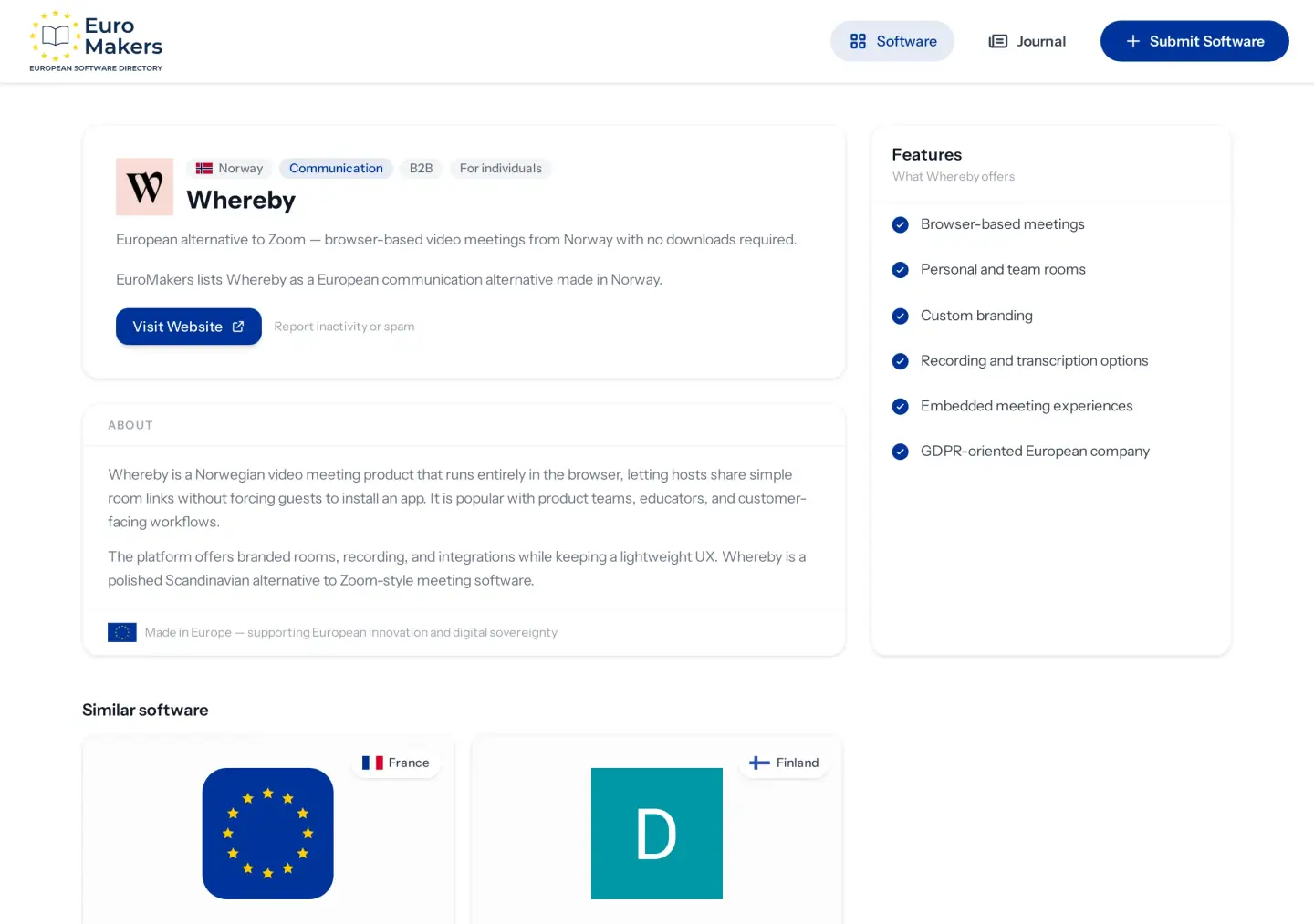
Whereby — Norwegian browser rooms with a calm door
Whereby, from Norway, is built for hosts who want video meetings that stay in the browser. Share a room link. Guests join without installing an app. Personal and team rooms, custom branding, recording and transcription options, and embedded meeting experiences cover product teams, educators, and customer-facing workflows that need a door that feels finished.
Choose Whereby when the job is a polished Scandinavian meeting house: simple links, branded rooms, and a lightweight guest path you can explain in one sentence. It suits teams that want European meeting craft with a calm customer door — not a self-hosted open stack as the first move. If you mainly want open-source conferencing you can host yourself, start with Jitsi.
A shortlist by how the door should work
- You want open-source meetings you can self-host → start with Jitsi Meet.
- You want a fast public room without accounts for basic use → try a Jitsi instance before you build the ops yourself.
- You want polished personal or team rooms with branding → try Whereby.
- You actually need all-day channels or a pocket messenger → stop — that is Element, Wire, Threema, or Olvid, not meetings stretched thin.
France specialises in an open meeting stack with self-hosting and strong European adoption. Norway specialises in a browser room with a calm guest door and branded hospitality. That spread is the point of a healthy European market — not two logos fighting over the same call.
How to trial without stranding your guests
Meeting swaps fail when people announce a big cutover and abandon the old room on day two. Keep the first fortnight reversible.
- Pick one door craft: open rooms you can host, or a polished Norwegian browser room with branding.
- Send one real guest link first — a client check-in, a teaching hour, or a weekly stand-up — and use only that house for ten days.
- Test the boring moments: join from a phone, share a screen, mute chaos, a late arriver, and a reconnect after wifi drops.
- Check the host path: room reuse, recording if you need it, branding if clients see the door, and who can create rooms.
- Only then widen the circle, retire the old link for that job, and leave chat and mail on their own seats.
Where Made in Europe feels premium
Made in Europe matters in meetings when it shows up as craft: a guest door that does not punish visitors, a path to host when you need it, branding that feels finished, and products that treat live conversation as something worth preparing — not as another install race. It is a premium quality label when the room feels built for people who meet carefully, not loudly.
There is also a quiet unity story here. A French open meeting stack and a Norwegian browser room can sit in the same European market without pretending to be the same product. European software is often strongest when countries specialise — and when you keep sibling seats clear instead of stacking four apps that fight for the same Tuesday.
Choose the meeting door that matches how guests should arrive, not the one with the loudest feature list.
— EuroMakers Journal
Start here
Open the Communication category, read Jitsi Meet and Whereby, and run one careful fortnight with real guests. If team chat or pocket messengers are next instead, keep the shelf clear with our team chat guide, messengers guide, and conversation shelf essay. Building a wider European stack? Browse the directory or keep reading the Journal. Missing a European meeting tool we should know about? Tell us.
Find your next European tool
Browse a curated directory of software made in Europe across every category your team relies on.
Explore the directory
