The European Guest Door That Sticks
How one European meeting link earns a place in an ordinary week — and why guest doors stick when full conversation migrations bounce.
The EuroMakers Editorial Team
Researching European software

The Journal · Made in Europe
Most European conversation swaps fail in the first fortnight for a boring reason: they ask everyone at once. New messenger for family. New team chat for the company. New meeting link for clients. By Friday the old defaults have quietly returned — not because Europe lacks calm rooms, but because three habits cannot relearn themselves on the same calendar.
The swap that sticks is smaller. Someone opens the EuroMakers Communication category, keeps chat and mail alone, and changes only the guest door — the link they send when a face and a shared screen are required. One European meeting product. One week. One real guest list. That is the story this essay follows.
A Tuesday that kept bouncing
Picture a familiar week. You sell services across two countries. Clients are polite and busy. Every call begins with the same scramble: which app, which account, which install before the first face. You already like your team rooms well enough. Mail works. The pain is the face-to-face seat — the five-minute check-in that becomes a fifteen-minute door problem.
That is the kind of swap that sticks. The annoyance is real. The job is frequent enough to rehearse. Failure is cheap: if the new link confuses people, you still learned what "good" means for guests. Our earlier essay on the European swap that sticks said the same thing in general. This piece follows one journey — the live-meeting door.
Why guest doors stick when chat migrations bounce
Team chat asks a whole hallway to move. Encrypted messengers ask trusted circles to relearn identity and invite habits. Mail asks threads, search, and muscle memory to relocate. A meeting door is narrower. Guests do not need to live there. They need to arrive once, see a face, and leave without adopting a new daily app.
- Feedback is immediate. A guest who cannot join tells you in the first minute — not three weeks later in a forgotten channel.
- The product is the path. Hosting model, account friction, and branding show up as hospitality, not as a feature brochure.
- You control the invite. You can keep old chat, keep old mail, and still send a calmer European link for the next five calls.
- Success feels boring. When the door stops being the story, the meeting can finally be the work.
"Made in Europe" helps here as a premium quality label — craft, restraint, and products shaped by makers across the continent — not as a loyalty oath. French open meeting stacks and Norwegian browser rooms are different crafts under one quality bar. You are choosing a doorway guests will keep opening, not collecting flags.
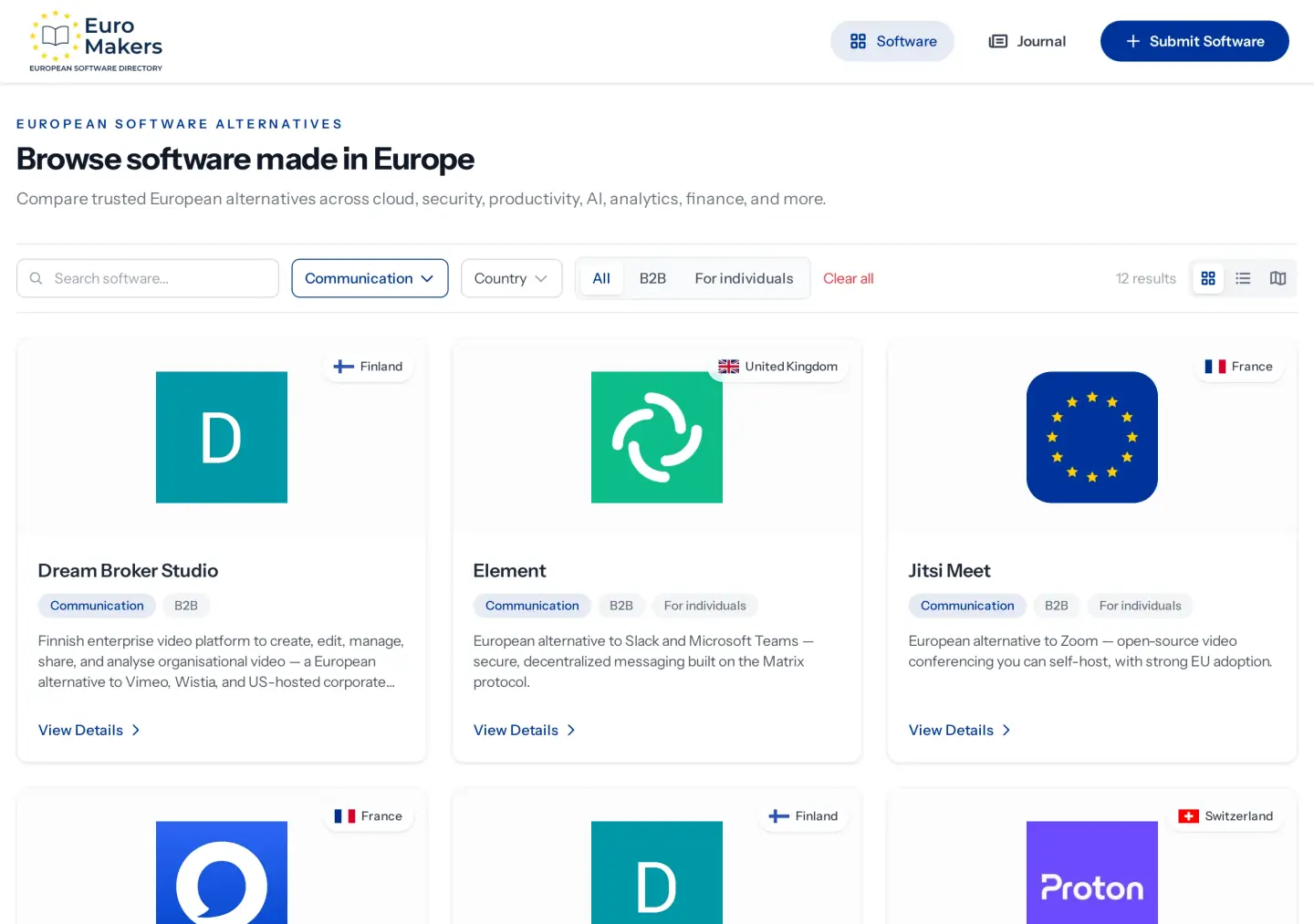
Pick the door craft, not the feature sheet
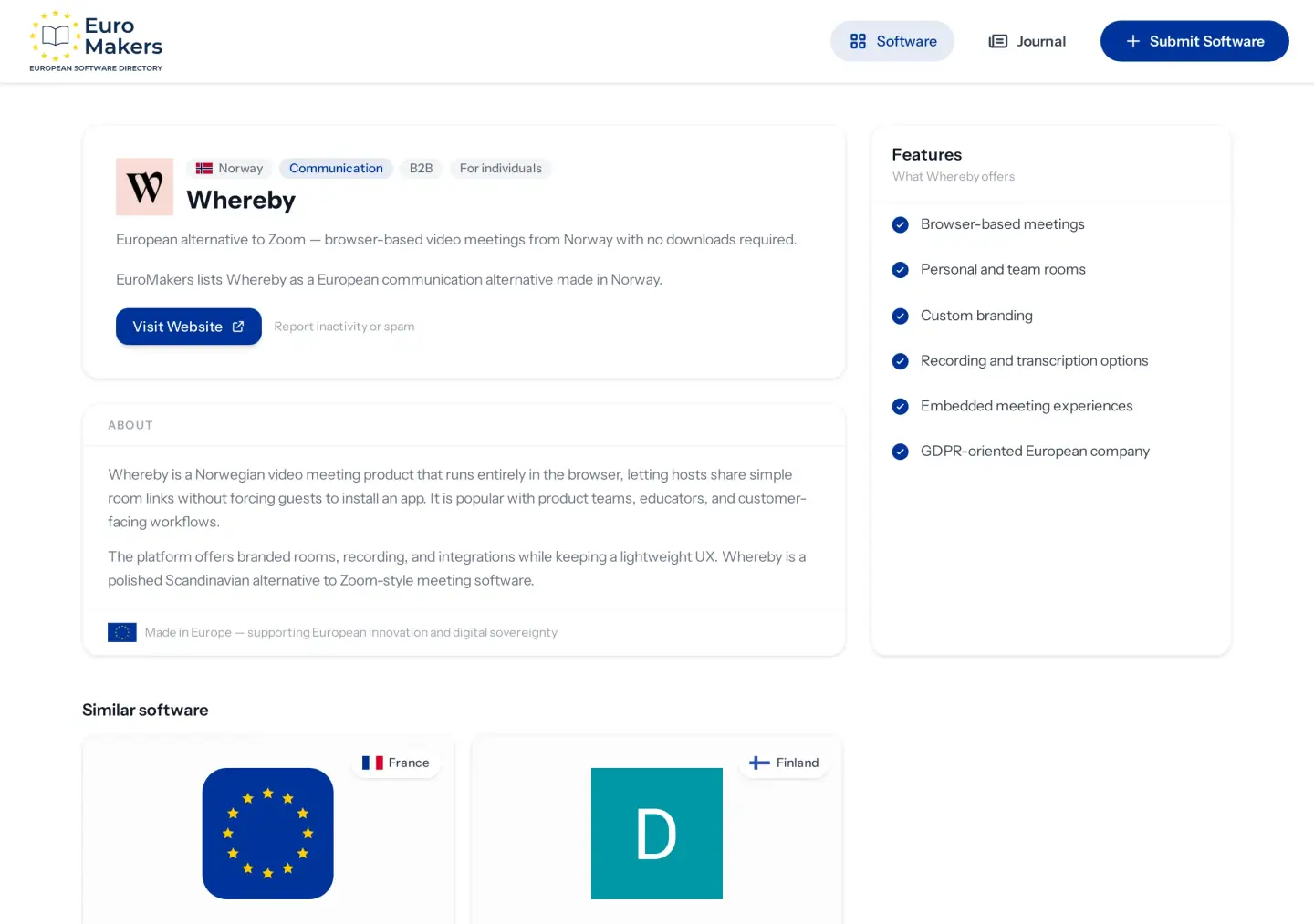
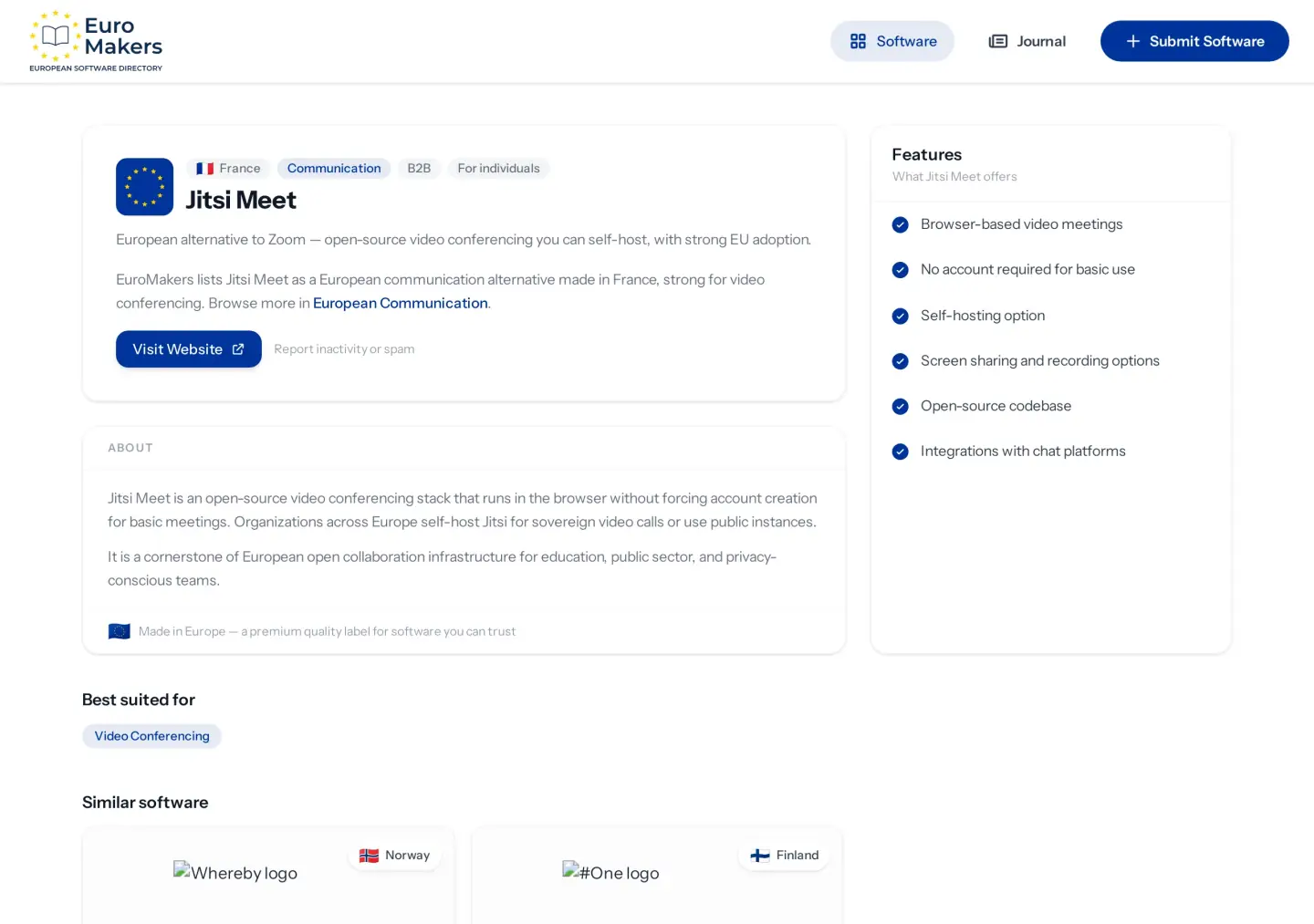
In EuroMakers, two listings carry this face-to-face seat with different crafts. Jitsi Meet from France is the open meeting stack you can host yourself — browser-based, no account required for basic use, strong when the room should live under your own roof. Whereby from Norway is the polished browser room: share a simple link, skip the install, and brand the welcome when clients deserve a calmer door.
Do not crown one winner across both. Write the sentence for your week. If you need open rooms you can host for education, public work, or quieter control, shortlist Jitsi. If you need personal or team rooms with a branded guest path, shortlist Whereby. Details live in the video meetings guide. The sticky swap only needs one of those sentences — and seven days of real invites.
What not to swap in the same week
Leave the rest of the conversation shelf alone while the door earns its place. Element and Wire are team rooms — a different hire. Threema and Olvid are pocket trust crafts — another hire. Mail still belongs to Tuta, Proton Mail, and the email guide. The conversation shelf maps those seats so you do not stack four apps that fight for the same ping.
If your real pain is all-day channels or encrypted one-to-ones, do not force a meeting product to pretend it is chat. Return to the team chat guide or the encrypted messengers guide. Sticky swaps fail when one logo is asked to replace a whole hallway.
The goal is not a European conference poster. The goal is one guest link you would miss if it disappeared.
The five-invite Tuesday test
Run the door like a product trial, not a rebrand.
- Write the guest sentence in one line — browser join, self-hosted rooms, or branded hospitality.
- Open the software directory, filter to Communication, and shortlist two meeting listings — not seven chat apps.
- Pick one European door that matches the sentence. Keep the other as a spare, not a simultaneous experiment.
- Send that link for the next five real invitations. Score arrival friction, not brochure features.
- Keep the winner only when guests stop commenting on the door. Leave chat, mail, and messengers alone until this seat feels boringly reliable.
If neither door sticks, you have not failed Europe. You have refined the brief — maybe the pain was team rooms, not meetings. Come back with a sharper constraint, or tell us which guest path still feels thin. The Journal sits between what exists and what guests will still open next season.
Start with one door. Make the welcome excellent. Let the continent earn the next seat at the table.
Find your next European tool
Browse a curated directory of software made in Europe across every category your team relies on.
Explore the directory
